Garage Software: The Complete Guide for UK Independent Workshops in 2026
If you’re still running your garage on paper job cards, a wall planner, and a spreadsheet for invoicing, you already know it’s not working. Garage software replaces all of it. This guide explains what it does, what to look for, and what’s available for UK garages right now.

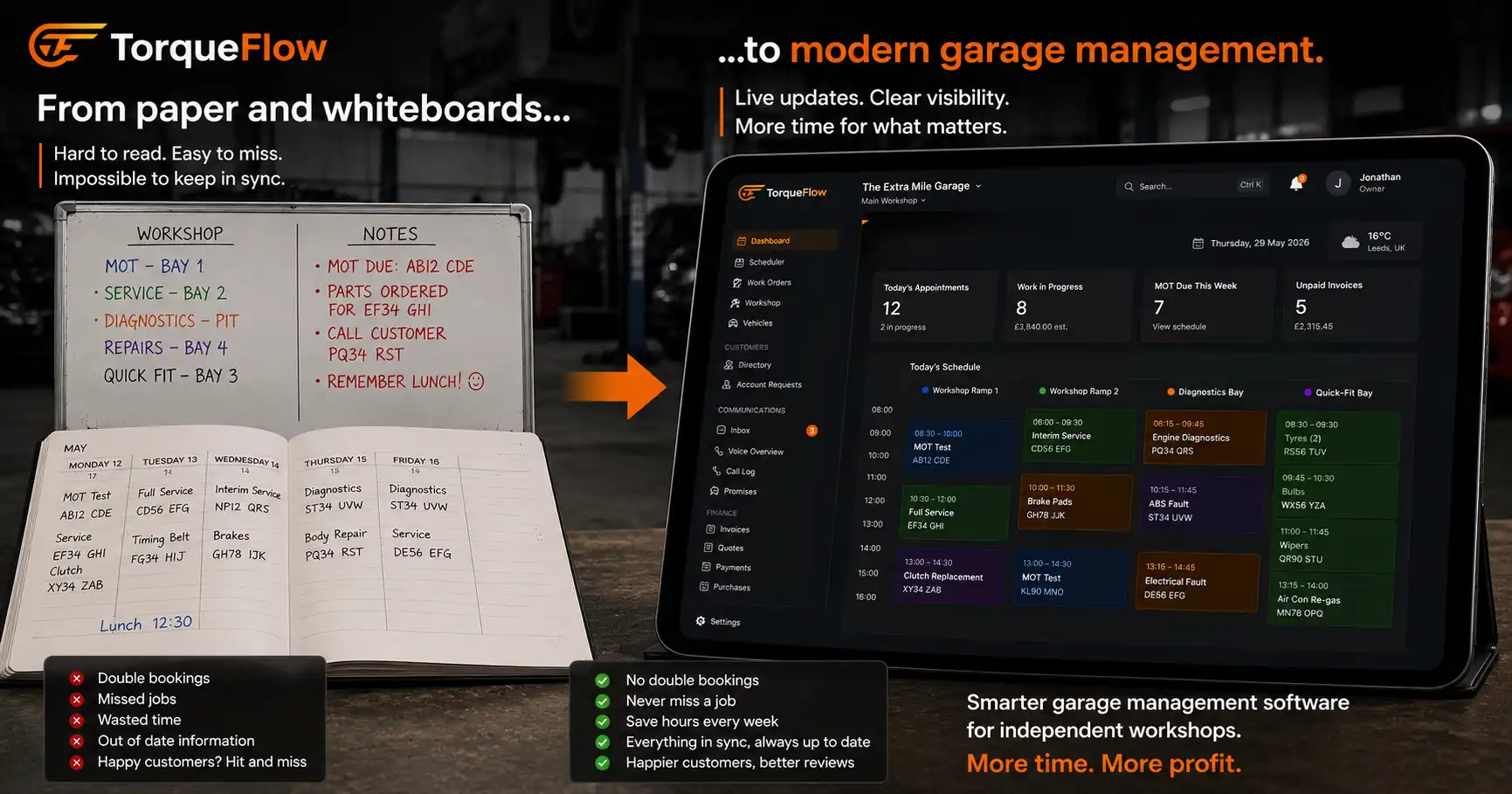
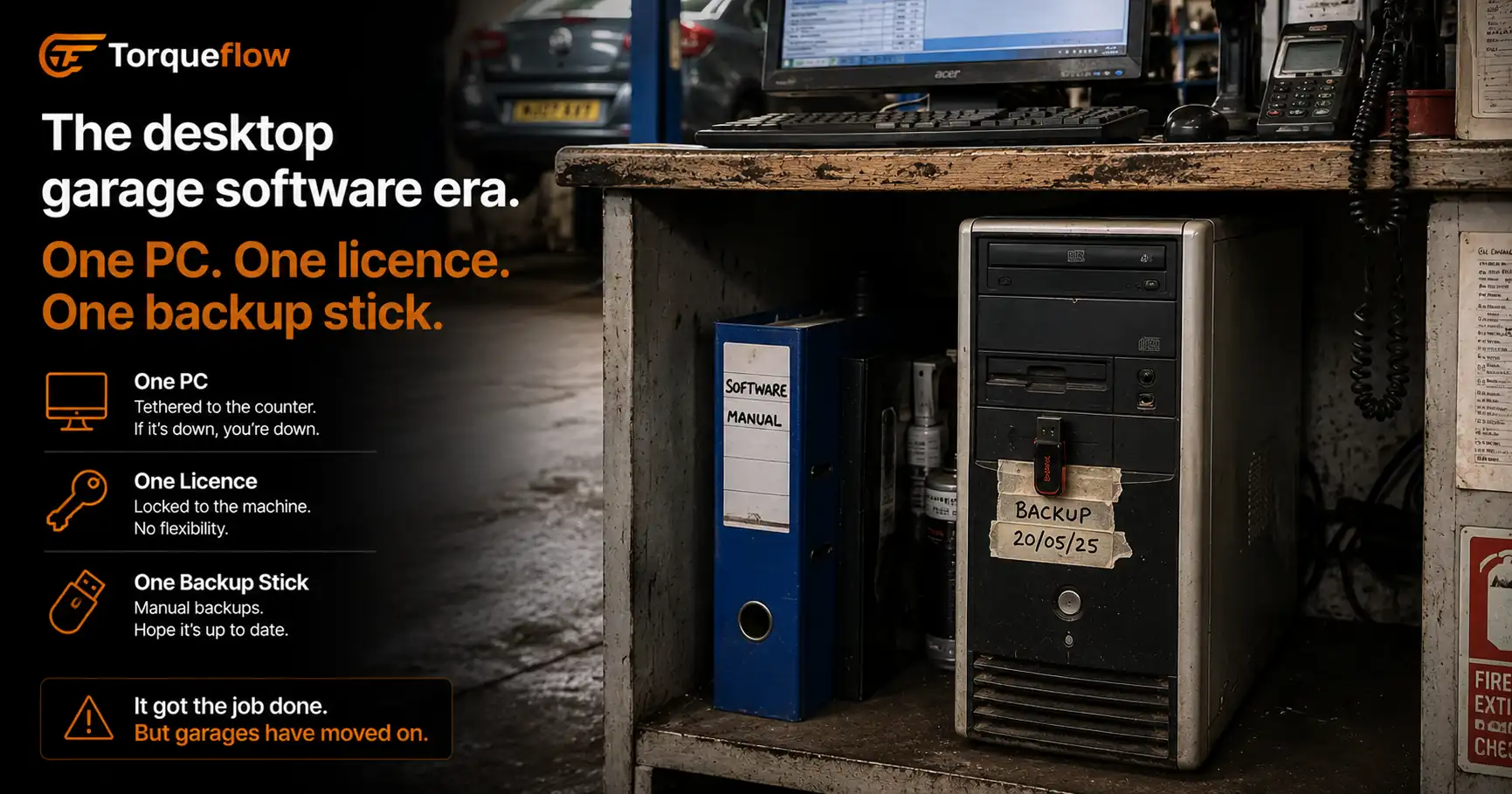
Ten years ago, garage software meant a clunky Windows desktop app that did job cards and invoicing. You installed it on one PC in the office, backed up to a USB stick, and hoped it didn’t corrupt the database. It was better than paper, but not by much.
The market in 2026 looks nothing like that. Modern garage software is cloud-based, runs on phones and tablets, handles everything from online booking to AI phone answering, and connects your workshop operations to your accounting package in real time. The gap between what a good system does and what most independent garages are actually using is enormous.
This guide is for garage owners and managers thinking about their first system, or thinking about replacing one that isn’t keeping up. It covers what garage software actually does, how the main systems compare, and how to make a decision without sitting through 15 demo calls.
Looking for the software itself, not a guide? Torqueflow is garage management software built for UK independents.
What garage software does (and what it replaces)
Garage software is a single system that runs your workshop. Not just one part of it. All of it. The job cards, the diary, the invoicing, the customer records, the parts ordering, the MOT reminders, the phone, the lot.
Here’s what each module replaces:
| What you’re doing now | What garage software replaces it with |
|---|---|
| Paper job cards or a whiteboard | Digital work orders linked to customers, vehicles, and invoices |
| A paper diary or wall planner | Online booking with bay and technician scheduling |
| Typing invoices into Xero or a spreadsheet | Invoices generated from the job card, synced to your accounting package |
| A customer list in a notebook or Excel | Customer management with vehicle history, contact details, and communication log |
| Phoning or texting MOT reminders manually | Automated reminders via SMS and WhatsApp |
| Answering the phone while under a car | AI phone answering that books appointments and checks job status |
| Checking stock by walking to the shelf | Parts catalogue with stock levels and supplier ordering |
If you’re only using one or two of these (say, just invoicing and job cards), you’re getting a fraction of the value. The real benefit comes when everything connects: the job card creates the invoice, the invoice syncs to Xero, the completed job triggers the next service reminder, and the customer gets a WhatsApp when the car is ready. No double-entry. No separate systems. One workflow from booking to follow-up.
Job cards and structured workflow management
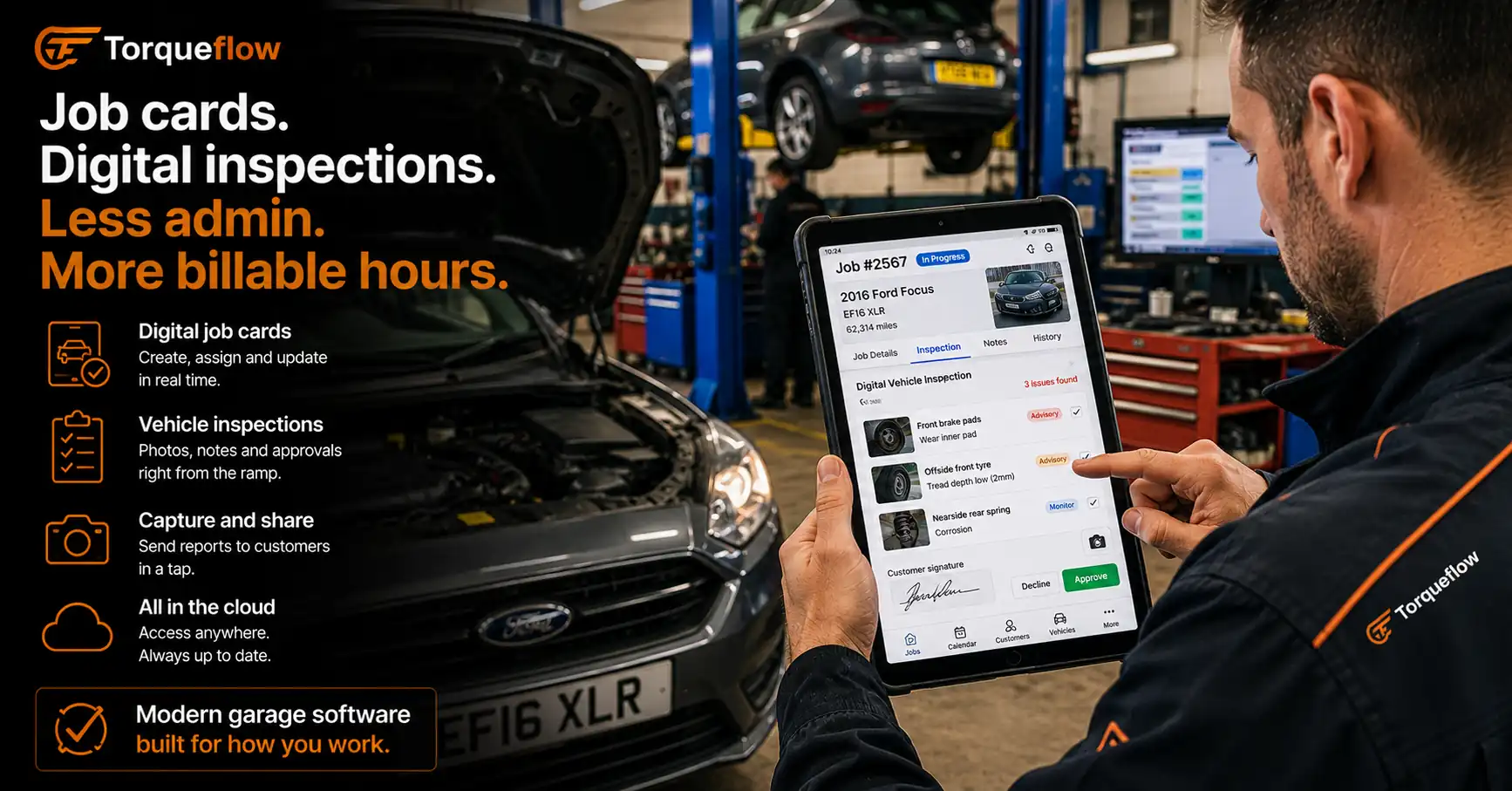
The job card is the centre of everything. When a vehicle comes in, the job card captures what needs doing, who’s doing it, what parts are required, and how long it should take. As work progresses, the technician updates the card. The service advisor sees the status. The customer gets notified.
In good garage software, the job card isn’t a static form. It’s a live document that moves through a structured workflow: booked, checked in, in progress, waiting on parts, quality check, ready for collection, collected. Each stage can trigger an action. “Ready for collection” sends a WhatsApp. “Waiting on parts” alerts the service advisor to chase the supplier. “Quality check” flags the job for a senior technician to review before handover.
This replaces the mental model where Dave knows what stage every car is at because he can see the workshop from the office. That works at one bay. It doesn’t work at three, and it completely breaks at six.
Read more about workshop management →
Booking, scheduling, and online diary management
Your diary needs to show more than just times. It needs to show bays, technicians, job types, and capacity. A 45-minute MOT and a 4-hour engine diagnostic don’t occupy the same slot. Good auto repair shop software understands this.
Online booking lets your customers book their MOT or service at any time, from any device. They pick a date, enter their registration (the system does a DVLA lookup for vehicle details), and confirm. The booking lands in your diary with the bay allocated and the job card started. No phone call needed.
Automated reminders go out before the appointment via SMS or WhatsApp. The customer confirms, reschedules, or cancels with a reply. Cancellations open the slot in real time for someone else. This alone cuts no-shows by 30-50%.
AI phone booking handles the customers who still prefer to call. The AI checks your schedule, finds a slot, books it in, and sends the confirmation. Your team doesn’t need to stop what they’re doing.
March and September are peak MOT months. A garage with proper booking software fills those weeks automatically through service reminders sent to every vehicle with an MOT due. A garage without it relies on customers remembering to call.
Read more about MOT booking software →
Invoicing, payments, and supplier management
Garage invoicing software needs to do two things well: generate sales invoices from completed jobs, and process purchase invoices from your suppliers.
Sales invoicing should be automatic. When a job is complete, the final invoice builds itself from the job card: labour lines, parts used, extras, VAT. The service advisor reviews it, clicks send, and the customer gets it by email or WhatsApp with a payment link. No retyping. No recalculating.
Purchase invoice management is where most garages lose hours. Motor factor delivers 30 parts, someone types every line into the purchase ledger. AI invoice scanning eliminates this. Forward the supplier’s email, snap a photo, or drag in a PDF. The AI extracts every line and matches it against your records. Review, click Confirm, done in 30 seconds.
Accounting integration pushes everything to Xero, Sage, or QuickBooks automatically. Sales invoices, purchase invoices, payments, credit notes. Your accountant sees clean data without you exporting CSVs or reconciling by hand.
Read more about garage invoicing software →
Customer management, communication, and retention
Your customer database isn’t just a list of names. In good garage software, each customer record holds every vehicle they own, every job you’ve done, every invoice, every message, every phone call transcript. Your service advisor can pull up Mrs Patterson’s history in seconds and see the advisory from six months ago that she hasn’t dealt with yet.
Automated service reminders go out based on MOT due dates, last service date, or mileage estimates. The system handles the timing and the message. You customise the template, choose the channel (WhatsApp, SMS, email), and the reminders run in the background.
WhatsApp and SMS messaging built into the system means your customer communication lives in one place. No personal phones, no lost threads, no “I think Dave texted them but I’m not sure.” Every message is logged against the customer record.
Aftercare messages go out automatically after collection. “How’s the car running?” Simple, personal, and it costs you nothing. But it’s the difference between a customer who comes back and one who tries the garage down the road.
This is customer management that actually drives repeat business, not just a contacts list.
Read more about customer communication →
Vehicle management, health checks, and service history
Every vehicle in your system carries a full service history: every job, every part, every advisory, every MOT result. When a car comes in, the technician sees what was done last time and what was flagged for future attention.
Digital vehicle health checks replace the paper multi-point inspection sheet. The technician works through the checklist on a tablet, marks items green/amber/red, takes photos of worn components, and the customer gets a visual report they can actually understand. Amber items become next visit’s upsell. Red items become today’s approval request.
Tyre management tracks tyre condition per vehicle. The VHC flags worn treads. The parts catalogue knows the right tyre spec. The quote goes to the customer with photos.
This data compounds over time. After two years, you know more about that Corsa’s history than the customer does. That’s how you become their permanent garage, not just the one they tried once.
Read more about vehicle health checks →
What separates good garage software from the rest
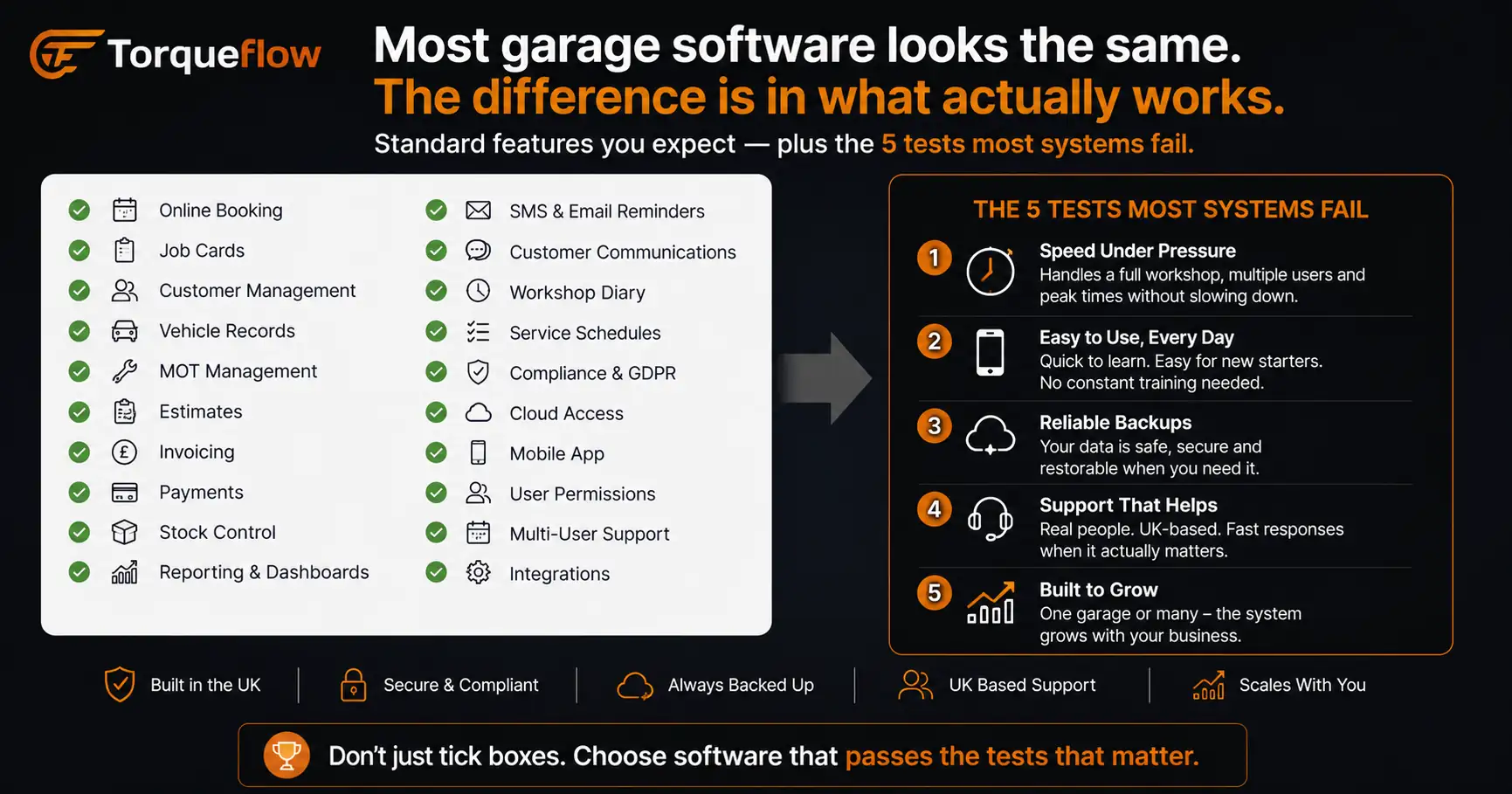
Every system on the market does job cards and invoicing. Here’s what separates the best garage software from the rest:
AI features built in, not bolted on. Voice AI that answers your phone and books from your live schedule. AI invoice scanning that processes supplier documents in seconds. Automated customer communication that sends the right message at the right time. These aren’t add-ons with separate pricing. In the best systems, they’re part of the platform.
Read more about AI garage management →
Cloud-based with real-time data. Your dashboard shows what’s happening right now, not what happened when someone last hit refresh. Cloud-based garage software means your team accesses it from any device, any location. No server in the office. No VPN. No “the system’s down because the PC crashed.”
UK-specific from the ground up. MOT integration, DVLA lookups, VAT handling, HMRC compliance, Xero and Sage accounting sync. If the software wasn’t built for UK garages, these will be missing or half-finished. Check before you commit.
Works for small to large workshops. A 1-bay operation and a 6-bay multi-site business need different things. The best garage software scales without forcing you onto an enterprise plan just because you hired a third technician.
What’s available for UK garages in 2026
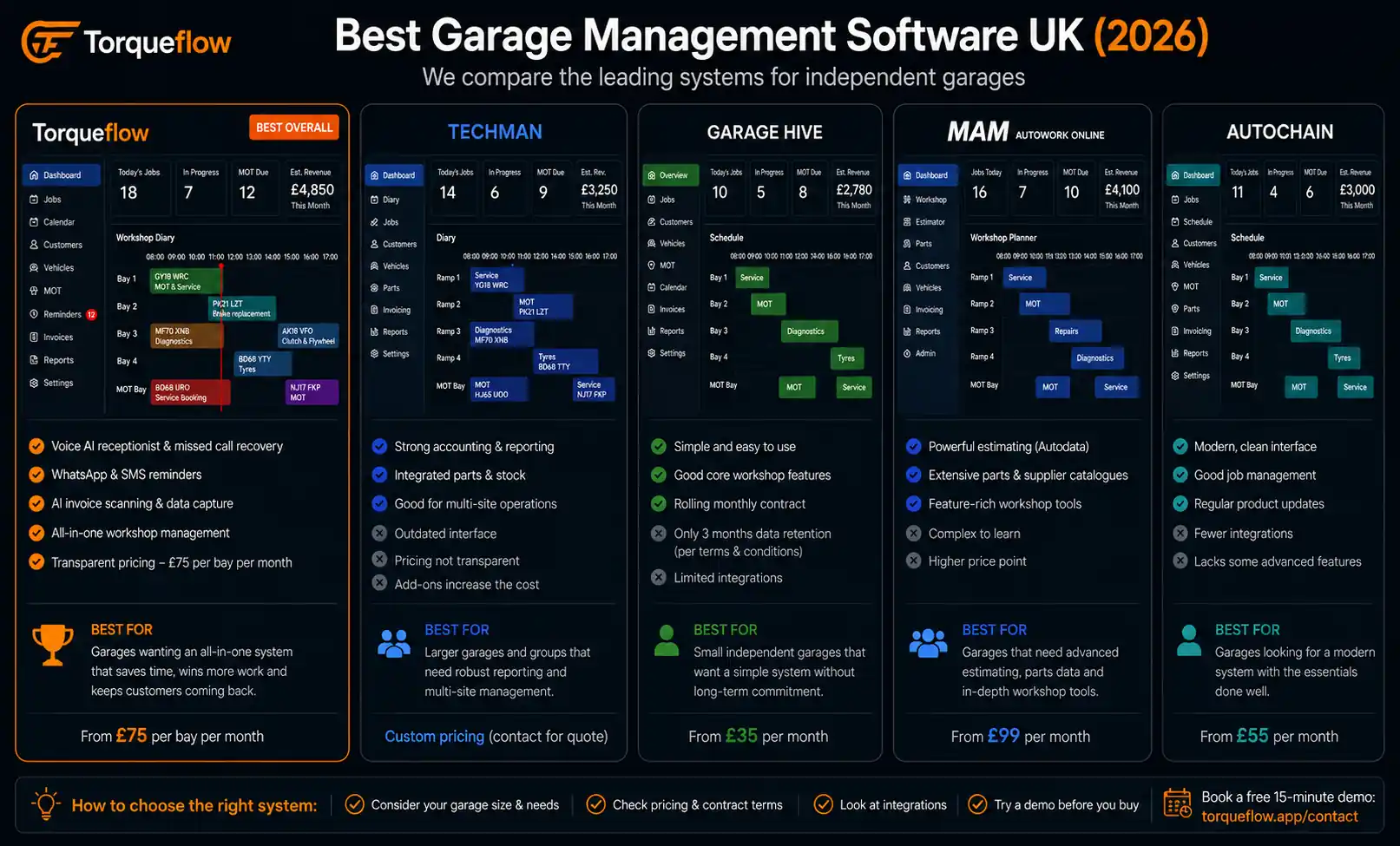
The UK garage software market has a handful of serious players. Here’s a quick landscape, not a comparison (for that, see the full garage software comparison).
Torqueflow is an all-in-one garage management software built for UK independents. AI phone answering, AI invoice scanning, WhatsApp automation, online booking, Xero integration, customer portal. Cloud-based, works on any device. Built from scratch in 2026 with AI at the core rather than retrofitted.
Garage Hive is the established name. Strong community, Microsoft Dynamics backend, partner ecosystem with parts suppliers. Well-regarded for workshop management. No built-in voice AI or AI invoice scanning as of mid-2026.
TechMan (TechMan GMS) is popular with larger independent garages and groups. Mature feature set for workshop and parts management. Known for comprehensive reporting. Pricing can be opaque.
MAM Autowork Online is the legacy option. Large installed base from the MAM/ECP era. Being replaced by many garages moving to cloud-based systems. If you’re currently on Autowork and frustrated, you’re not alone.
Auto Garage Network (AGN) is a newer entrant with a modern interface. Growing across the UK. Worth evaluating alongside the established names.
Dragon2000 offers garage management alongside dealer management. More focused on used-car operations than pure workshop management, but some independent garages use it.
For a small garage starting from scratch, the top garage software options are Torqueflow and Garage Hive. For garages switching from an older system, the switching guides below cover the migration path.
How to choose garage software for your business
Every garage owner who’s been through this process knows the pain: 10 websites, 5 demo calls, 3 free trials, and you’re still not sure. Here’s what actually matters.
Start with your pain point. If you’re drowning in paperwork, prioritise invoicing and job card automation. If you’re missing calls, prioritise AI phone answering and online booking. If customers aren’t coming back, prioritise automated reminders and customer communication. The best system for your business is the one that fixes your biggest problem first and handles everything else second.
Check the accounting integration. If it doesn’t sync with Xero or Sage properly (not CSV export, actual live sync), walk away. Double-entry is the single biggest time-waster in a garage office.
Test the mobile experience. Open the demo on your phone. If you can’t create a job card, check a booking, and send an invoice from your phone screen, the software wasn’t built for how garages actually work.
Ask about AI features. In 2026, AI phone answering, AI invoice scanning, and automated customer messaging are the line between modern garage software and last-generation software with a fresh coat of paint. Don’t pay 2026 prices for 2018 software features.
Check the pricing is honest. Per-user fees, per-SMS charges, per-invoice costs, integration add-ons. Add them up for your team size and volume. Some software that looks cheap at the headline price costs more than the expensive option once you add the extras. Look for value for money, not the lowest sticker price.
Use the free trial. Any garage software worth considering offers a free trial period. Use it with real data for a real week. If the setup process takes longer than a day, that tells you something about the software.
Frequently asked questions
Your garage runs on its software. Choose carefully.
The difference between a garage that’s growing and one that’s treading water often comes down to whether the back office is eating the owner’s day. Good garage software gives you the hours back. Bad garage software (or no software at all) keeps you chained to the desk, the phone, and the spreadsheet.
If you’re evaluating options, start a free trial with a system that covers your biggest pain point and test it with real work for a real week. That tells you more than any demo or feature comparison page.
Torqueflow is all-in-one garage management software for UK independents. AI phone answering, invoice scanning, WhatsApp automation, online booking, and Xero integration on one platform.