5 Things Your Garage Management Software Should Do (That Most Don’t)
Here are the five: answer your phone when you can’t, talk to customers on WhatsApp, read supplier invoices so nobody types them, give customers a portal instead of a phone queue, and scale to a second site without doubling your costs. Most garage management software in the UK does none of them in 2026. Job cards, bookings, and the MOT diary are table stakes; every system has those. These five are the tests that separate the field, and each comes with a question to put to any vendor. Including us.
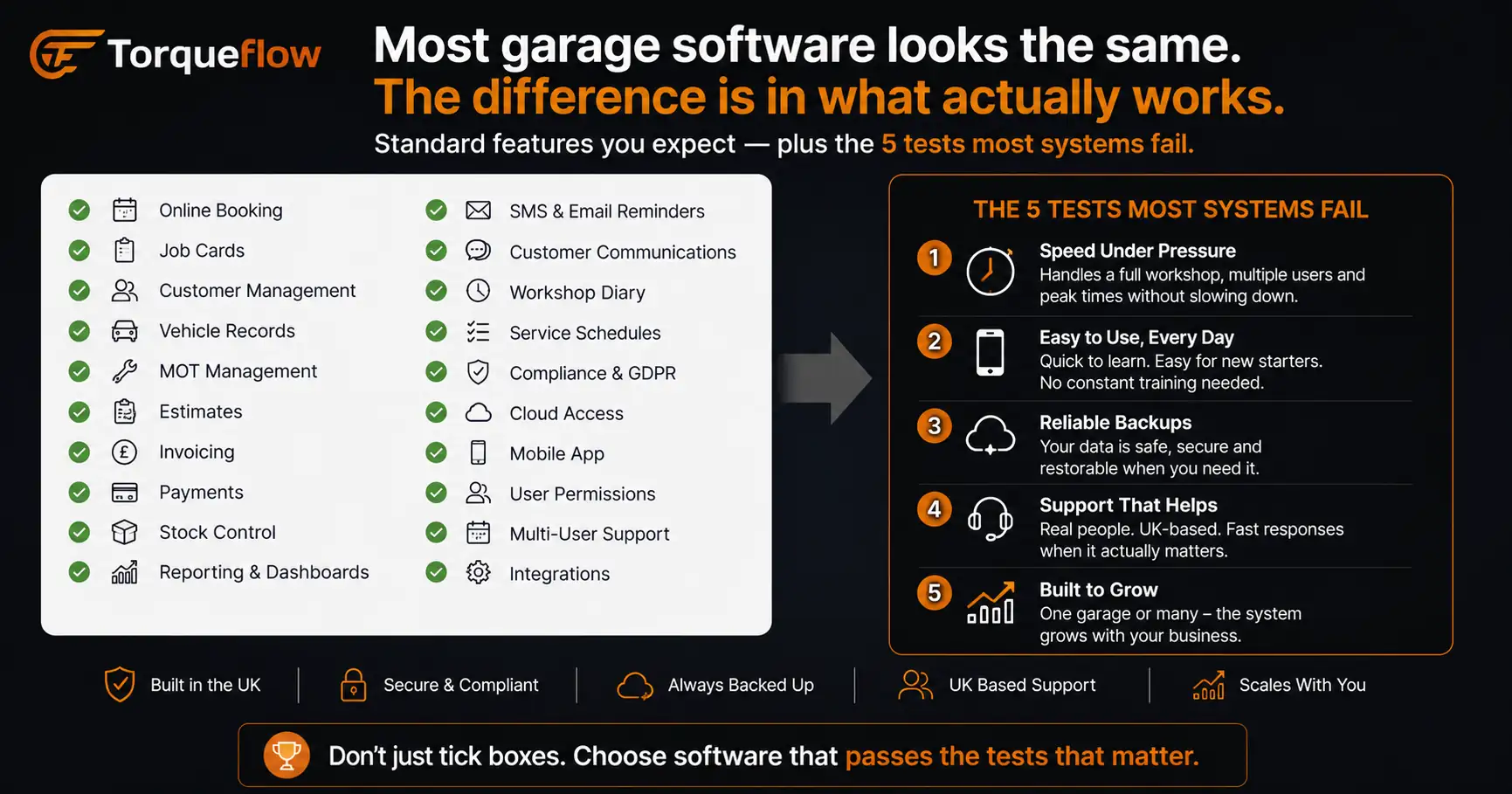
Search for garage management software UK and you’ll get vendor pages from Auto Garage Network to Garage Hive, plus a dozen lists of the top garage management software, every one claiming to be the best garage management system on the market. Read enough of them and something odd happens: they blur into one page.
“Structured workflow management.” “Smart garage software for the modern workshop.” “A complete garage management solution trusted by small and medium businesses worldwide.” “A workshop management system to simplify your service management.” “End-to-end software solutions.” “The #1 auto repair software.” Repair shop software built for American “auto repair shops” and “service centers”, rebadged for UK workshops with a pound sign, still describing “auto repair shop management” to a trade that books MOTs. And lists of garage management system features that all contain the same twelve bullets. The listicles of the best garage management software are no better; most are written by the vendors themselves. (Ours is too. That’s why every section here ends with a test you can run on anyone, not a scorecard we marked ourselves.)
And here’s the thing those identical lists accidentally prove: if every garage system has the same essential features, the features that matter are the ones missing from the lists.
Table stakes: what every system already does
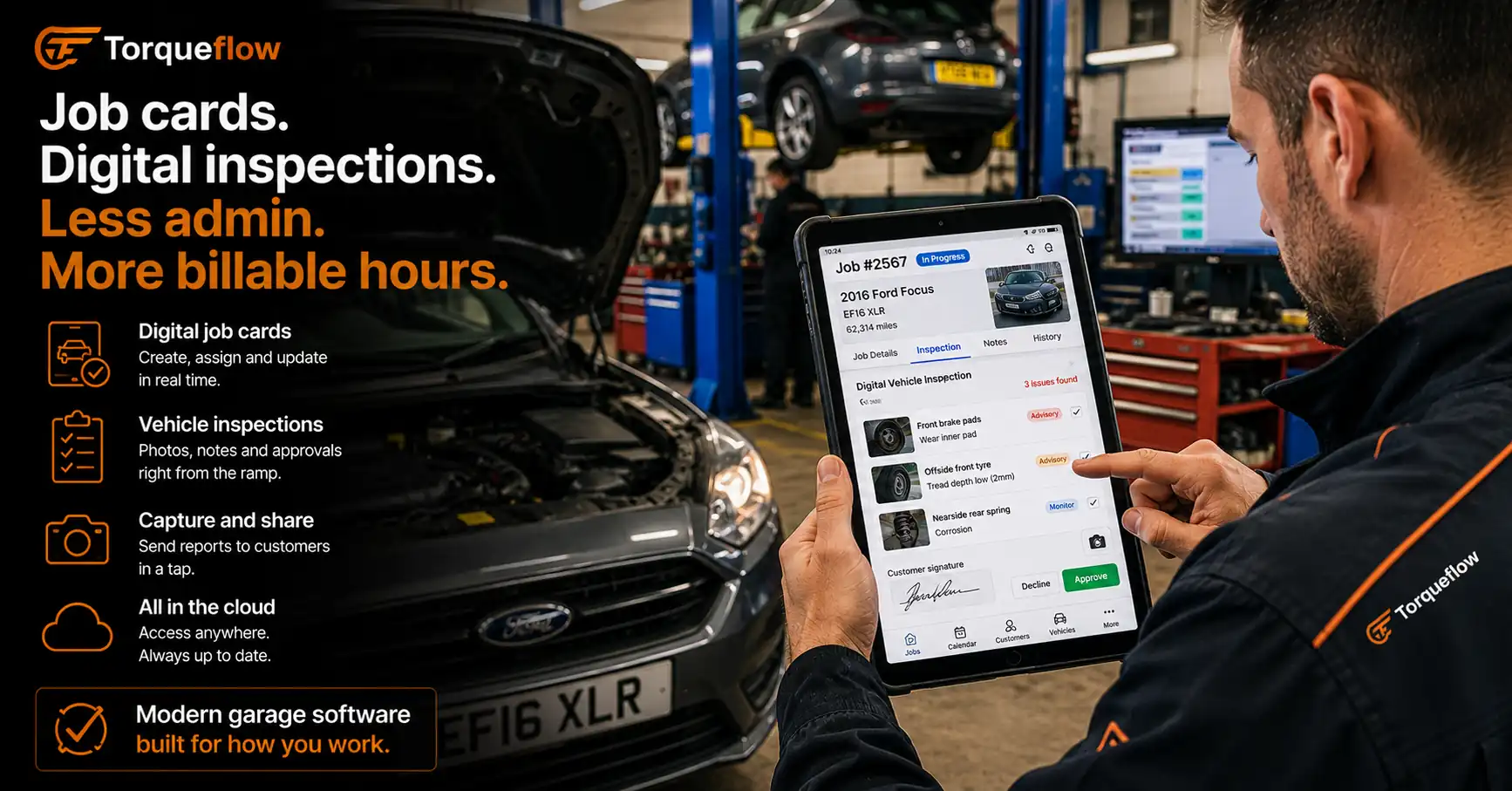
Let’s clear the floor first. Digital job cards, online booking, invoicing, the MOT diary, vehicle history, parts inventory, a dashboard, technician scheduling, accounting software sync with Xero or Sage or QuickBooks. That’s the baseline of workshop management software in 2026, on either side of the automotive repair trade’s price range. Any workshop software that can’t do all of it isn’t a contender, and almost none fail this bar.
So when a vendor demos “key features” like automated MOT reminders or inventory management, they’re showing you the equivalent of a car with wheels. Nod, and ask about what follows.
1. It should answer the phone when you can’t
The phone is where garages bleed money, and it’s the one channel most garage management software ignores completely. The software runs the diary; the phone that fills the diary rings out at the counter, because both technicians are under cars and the owner’s elbow-deep in a brake job.
The maximum MOT fee is £54.85. Every missed booking call is that plus whatever the test finds, gone to whichever workshop answered. A voice AI that picks up, checks the live schedule, and books the job turns the worst hour of the morning into bookings instead of voicemails.
Most systems don’t do this today. The AI announcements are starting across the industry, which makes the test more important, not less: a chatbot bolted onto a website is not a receptionist.
The test: ask the vendor to call their own demo line with you listening. Can it see a real diary? Can it actually book, not just take a message? See how the Voice AI works →
2. It should talk to customers on WhatsApp
Your customers organise their lives on WhatsApp, and customer communication is now half the front-desk job. Yet most garage software still treats SMS and email as the only channels, with marketing features like bulk campaigns standing in for actual conversation.
The difference shows up in the numbers garages already know: letters get binned, emails sit unread, texts get a reply. WhatsApp gets a reply with a photo of the dashboard warning light attached. Booking confirmations, MOT reminders, approval requests with the technician’s photos: send them where the customer already is, and the customer answers.
The test: send the vendor’s demo system a WhatsApp message and see what happens. If the answer involves “our SMS add-on”, that’s a different thing wearing the same hat. Read about customer communication →
3. It should read supplier invoices so nobody types them
Here’s the workflow nobody puts on the feature list: parts arrive, delivery note goes on the pile, and at some point someone retypes it all into the system. Parts management by keyboard, every evening, forever.
This is the most automatable work in the building. Photograph the supplier invoice and the lines should land in stock, costed, with your markup applied and the parts against the right job. The invoice to the customer then builds itself from the work that was actually done. Automate the typing and you improve efficiency where it’s purely waste; no customer ever paid more because your evenings were spent on data entry.
The test: hand the vendor a real supplier invoice at the demo and watch what their system does with it. A photo should be enough. See AI invoice scanning →
4. It should give customers a portal, not a phone queue
Count how many calls a day are some version of “is my car ready?” Each one interrupts the desk, and each one exists because the customer has no other way to see their job status.
Customers now expect transparent service because every other trade they deal with provides it. They track the parcel, the pizza, the plumber. A customer portal does the same for the workshop: booking online, approving the work from the health-check photos, seeing the vehicle history, paying the invoice from their phone. Remote access to their own car’s story, without ringing you for it.
This is the feature that changes the customer experience rather than your admin, which is exactly why it gets skipped: the buyer of garage software rarely experiences their own front desk from the customer’s side.
The test: ask to walk through the demo as a customer, not as the garage. If there’s no portal to walk through, you have your answer. See the customer portal →
5. It should scale to a second site without doubling the admin
Garage owners across the UK open second sites, and their software is rarely ready. The pattern to watch is per-user pricing: a second site means more service advisors, more technicians, more licences, and suddenly the management platform costs scale with headcount rather than with the business.
Multi-location support isn’t a copy of the system per site. It’s one view of workshop operations across both: shared customer records, stock visibility between sites, the schedule for both forecourts on one screen. Two sites shouldn’t mean two data systems. Some management systems sell this as an enterprise tier; it should be a setting.
Even if a second site is years away, ask anyway. The answer tells you how the vendor thinks about your growth, and whether choosing them now means choosing again later.
The test: “what changes, and what does it cost, when I open site two?” A good answer is a number. A bad answer is a callback. See multi-location →
How to choose: run the five tests
For independent garages, choosing management software for your workshop comes down to two layers. The baseline layer, every vendor passes; stop spending demo time on it. The differentiating layer is these five, and the right garage management software is whichever management tool passes the tests that match how your garage operations actually run. A one-man mobile operation cares about test three. A busy MOT station cares about tests one and four. An ambitious two-site operation cares about five. Any modern garage software should pass at least three of them.
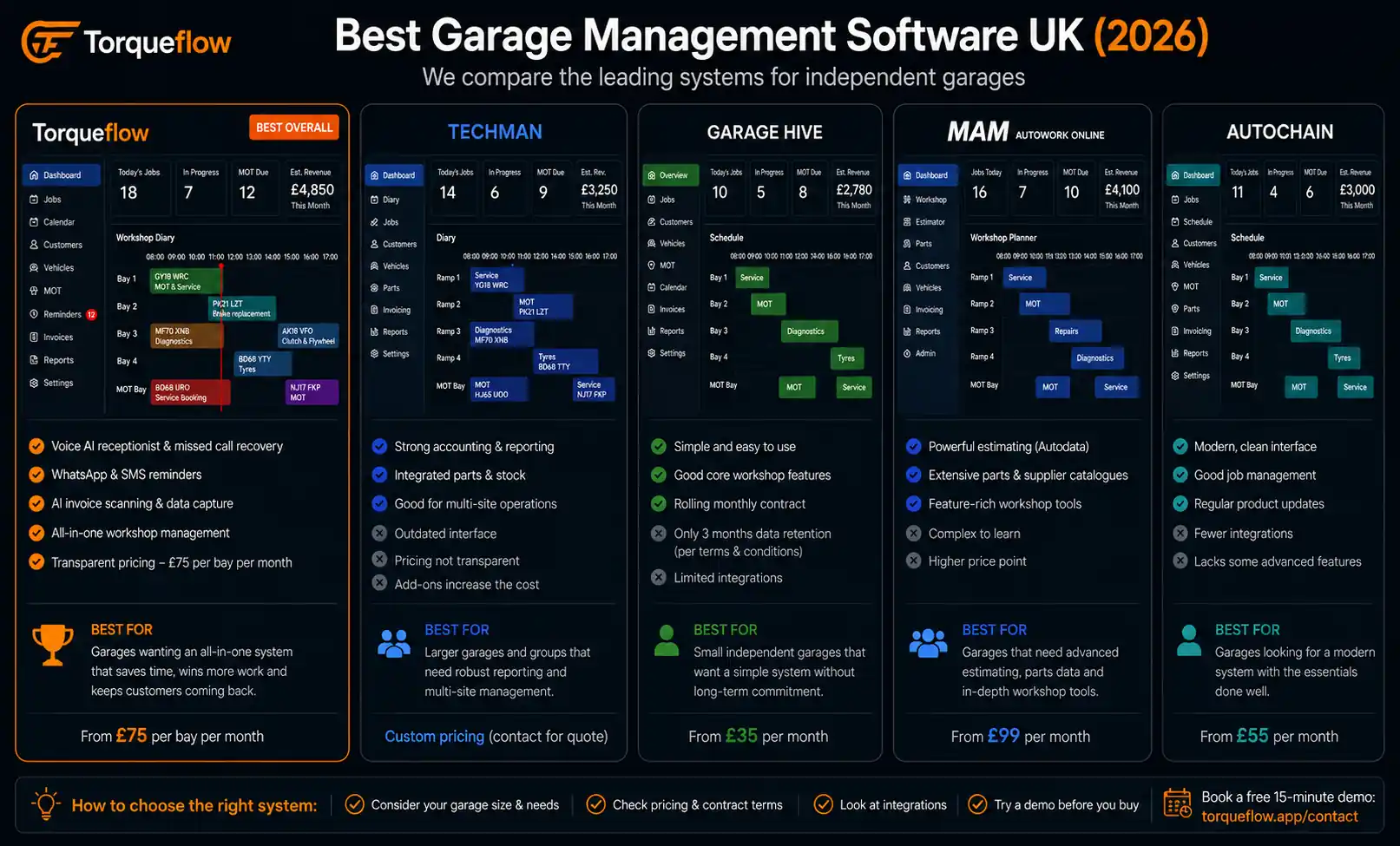
There’s no single best tool, and any “best garage software” list that doesn’t ask how your workshop runs is a brochure. For the structured version of the decision, work through the garage management system guide →, and for verified feature-by-feature data on the systems UK garages use, the garage software comparison → has the matrix, with sources.
And yes, the five tests apply to us. Book a demo and run them: call the Voice AI live, send the WhatsApp, bring a real supplier invoice, walk through the portal as your own customer, and ask the site-two question. That’s thirty minutes, and you’ll know more than any feature list can tell you.
Torqueflow is built to pass all five. Per-bay pricing, everything included.