Marketing for Auto Repair Shops: How UK Garages Get More Customers in 2026
Marketing for auto repair shops comes down to three jobs: stop losing the customers you already have, make sure local drivers can find you, and own the booking when they try to give you money. Most marketing advice obsesses over the middle job and ignores the other two. This guide runs in the order that pays: repeat business first, then visibility, then the paid channels everyone starts with and should really finish with.
A bias declaration before anything else. I build Torqueflow, garage management software for UK independents, so when reminders and booking systems come up I’m selling as well as advising. Judge the argument on the specifics.
And a warning about the genre. Nearly every guide to auto repair shop marketing is American. Search the phrase and you’ll wade through auto shop marketing listicles telling shop owners to “optimize the funnel”, launch loyalty programs, discount tire rotations and get active on Yelp. Yelp barely registers in Britain. Postcards went out with the fax machine. Automotive repair is the same trade on both sides of the Atlantic, and parts of the automotive marketing playbook translate fine. But the rhythm underneath doesn’t, because a UK garage runs on a calendar those guides don’t know exists: the MOT.
Why auto repair marketing works differently for a UK garage
More than 30 million MOT tests go through DVSA’s system every year, and due dates cluster in March and September. That one fact shapes effective auto repair shop marketing here more than any channel decision. Your busiest weeks were decided up to a year in advance, car by car, and the exact date each test falls due is sitting in the DVLA record.
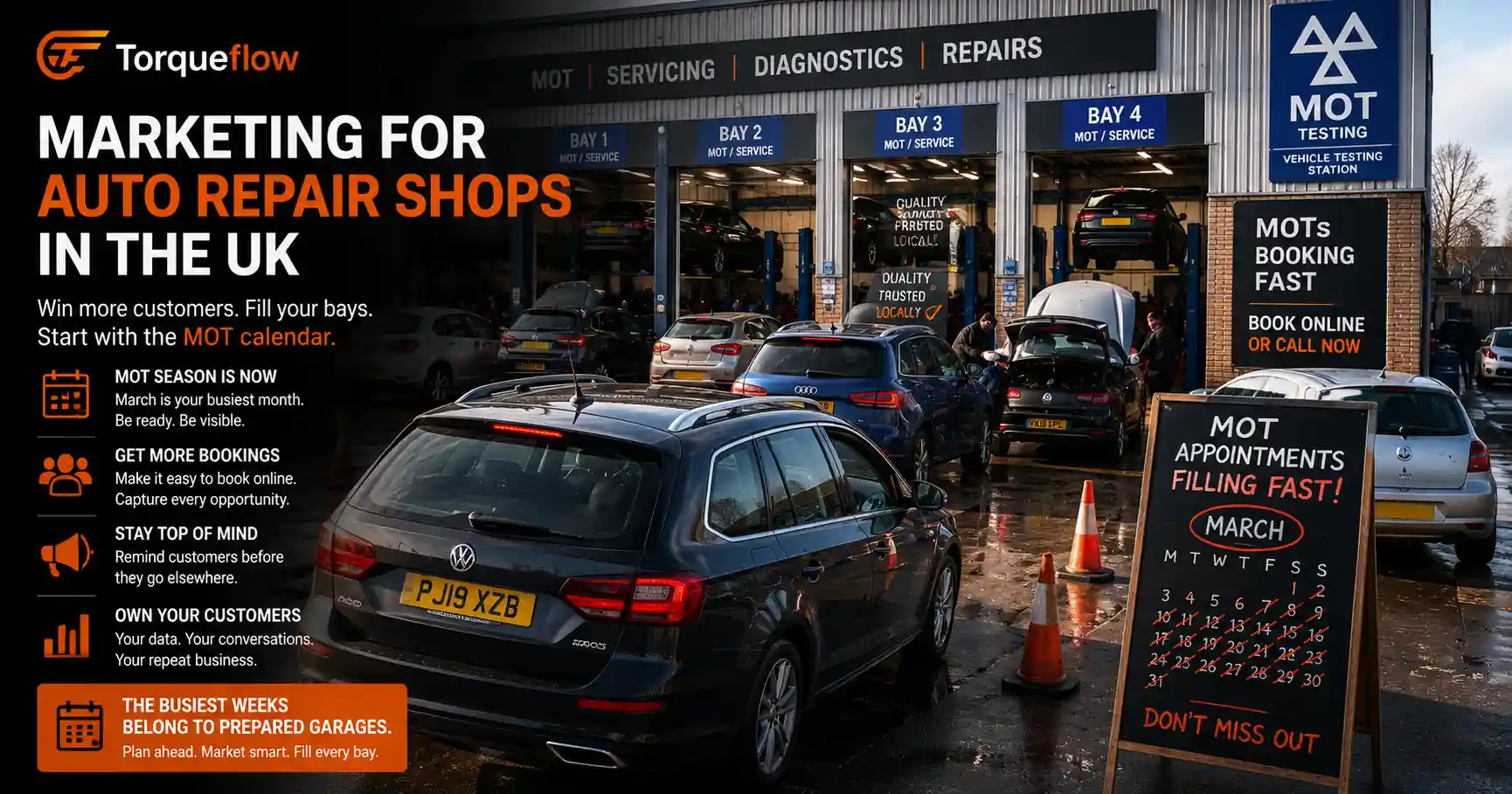
Which means the highest-value marketing messages a garage can send aren’t adverts at all. They’re reminders. “Your MOT is due on the 14th, shall we book you in?” beats any billboard, because it reaches the one driver who needs you this month at the moment the need exists.
The MOT is also capped at £54.85 for a car, so it’s a rotten product to advertise on price and a brilliant one to use as a door. The margin lives in what the test finds and the service booked alongside it. Hold that thought for every marketplace that invites you to compete on a £30 MOT.
So which marketing matters most? Most lists of auto repair shop marketing strategies rank channels. The better strategies for auto repair shops rank customers: the ones you have, the ones searching nearby, and only then the ones you pay to reach.
Repeat business first: the cheapest new customer is the one you don’t lose
Every successful auto repair shop I’ve been inside wins here before it spends a pound anywhere else. The maths is blunt. A retained customer books an MOT and usually a service every year, brings the second car, and sends their neighbour. Work out your average repair bill from last quarter’s invoices, multiply by the visits a loyal customer makes over five years, and compare that with what an ad click costs. New customers are the expensive kind.
And the leak is real. Drivers don’t leave because you did bad work. They leave because eight months later a marketplace email or a dealer letter got to them before you did. The retention fix is mostly automation, not effort:
- MOT reminders, sent automatically. Torqueflow checks the DVLA due date and messages the customer by text or email at 60, 30, 14 and 7 days before expiry, without anyone remembering to do it. Automated reminders are the closest thing this trade has to free money; there’s a whole piece on making MOT reminders people actually open.
- Service reminders off the service history. The car that had brake pads at 60,000 miles is a known future job. Marketing automation here just means the diary talking to the customer records.
- A follow-up message after the work. “All OK with the car?” two days after collection catches problems before the review does, and it’s the natural moment to ask for one.
- A reason to come back. Forget points cards. Small discounts on future services for both ends of a referral do the same job with less admin.
A customer who trusts you with diagnostics rarely price-shops the follow-up work. Keeping that trust warm is the whole game, and there’s more on it in how to keep customers coming back.
Own your booking front door
When your marketing works, a driver decides to book. What happens next decides who owns that customer: you, or a platform standing between you.
The marketplaces are the tempting shortcut. BookMyGarage’s Accelerate package starts at £149 a month plus VAT and a fee for every attended booking, and its standard listing takes its cut per completed booking (prices checked July 2026). In exchange your garage appears in a price-comparison list next to every competitor within five miles, usually sorted by who’ll do the cheapest MOT. Remember the £54.85 cap. You’re paying commission to win a race to the bottom on your lowest-margin product.
There’s a practical snag too. In March 2026 BookMyGarage announced an integration that places bookings straight into Motasoft’s Virtual Garage Manager. Run Motasoft and that’s genuinely useful. Run anything else and each marketplace booking arrives as a message somebody still has to key into the diary, with no idea whether the slot it promised actually exists.
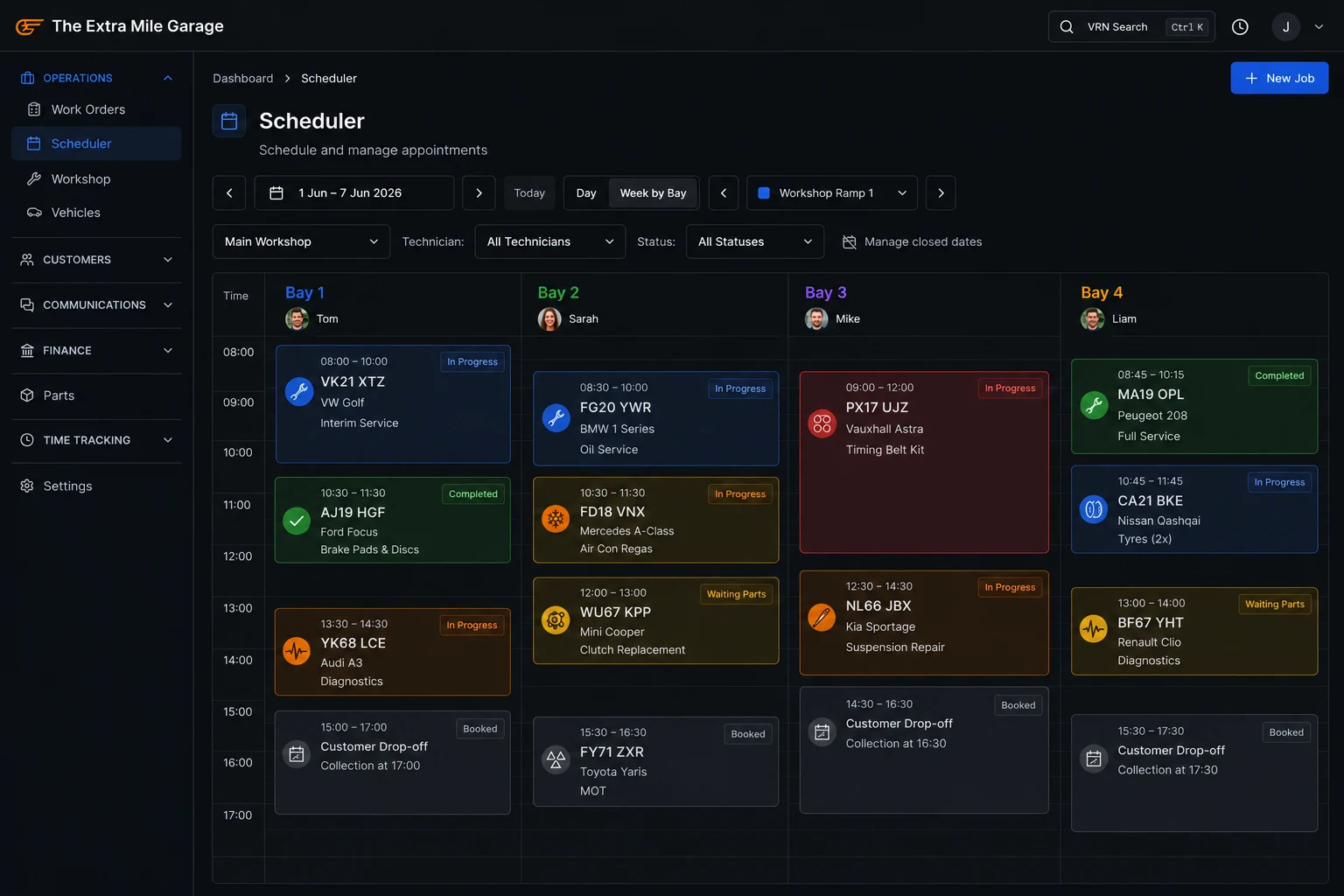
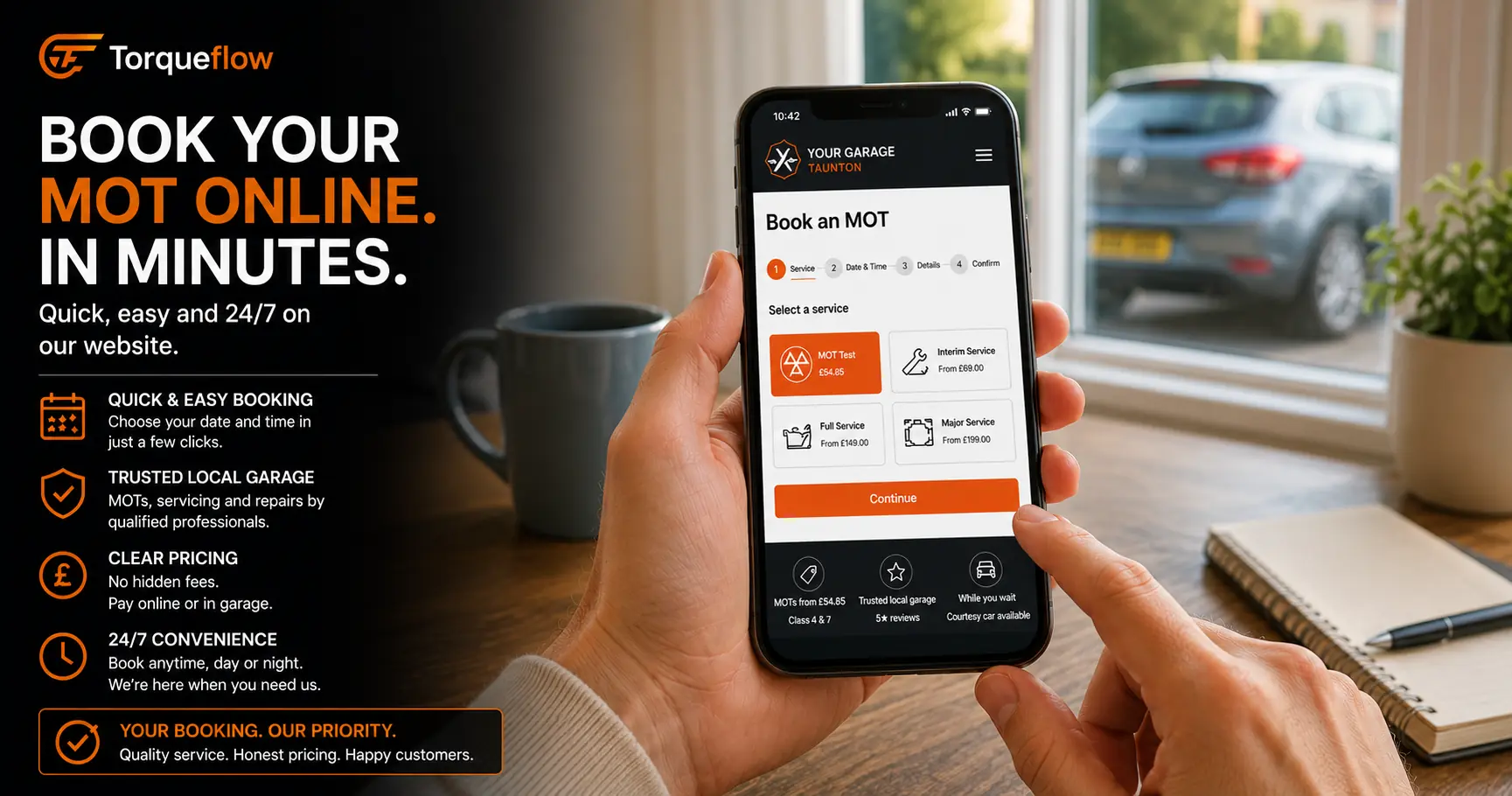
The alternative is an online booking system on your own website, wired to your real diary. This is the part where I’m selling, so here are the specifics to judge. Every Torqueflow garage gets its own booking page, and you can embed it on your own site so customers never leave it. You choose which services are bookable. Available slots are worked out from the bays that can actually do the job, so an MOT is only ever offered where there’s an MOT bay free, and the booking lands in the scheduler like any other. And you can take a deposit through Stripe that comes off the final bill, which does more to stop no-shows than any reminder ever will. A couple of no-shows a week is £300–400 in dead bay time; the no-show problem has its own guide.
No commission per booking. No comparison table. The customer, their car and their service history stay yours.
But don’t read this as “never list anywhere”. A marketplace can fill a quiet Tuesday while your own channels grow. The mistake is renting your only front door from a platform whose business model improves the more your customers price-shop. I’ve written up what the marketplaces teach us about customer loyalty separately.
Google Business Profile: the free visibility most garages half-fill
Type “auto repair near me” or “brake repair near me” into a phone and the map results appear before any website. For a local trade, that map is the highest-intent shelf on the internet, and your place on it is set by your Google Business Profile. It’s still “Google My Business” to most of the trade; the old Google My Business listing became the Business Profile in 2021, and it remains free.
Most garages claim theirs, fill in half of it and never look again. The half-hour version:
- Set the right categories, opening hours, phone number and website link, and add your booking page link.
- List your actual services with prices where you’re happy to show them.
- Add real photos: the bays, the waiting area, the team, the courtesy cars. Stock photos scream “we didn’t bother”.
- Post occasionally. An MOT-season note in February and August costs ten minutes.
Then reviews, because word-of-mouth now happens in online reviews. Local search results reward the garage with 200 recent reviews at 4.8 over the one with 30 at 4.9, and potential customers read the newest five before they read anything else. Successful shops make the ask a habit: the follow-up message after every job includes the review link, and someone replies to every review, including the stroppy ones. Calm replies to unfair reviews win more work than the five-star ones, because that’s the moment a reader learns how you handle a complaint. Pull the best lines onto your website as customer testimonials while you’re at it.
That review-and-respond loop will do more to attract more customers than any amount spent on adverts, and more to boost your auto repair shop’s standing on the map too. It compounds. Ads stop the moment you stop paying.
Local SEO beyond the map
SEO for a garage isn’t a dark art, it’s mostly having a page for each thing you do. If your site is one homepage with a phone number, Google has nothing to rank for “clutch replacement” or “air con regas”, and search results will hand those jobs to whoever does.
The useful minimum: a page per major service, your town named naturally on each, prices or price ranges where you can, and the booking page linked from everywhere. Add a short seasonal email or page of car maintenance tips if you enjoy writing; it keeps you remembered between visits, but it’s the garnish, not the meal. Local SEO for local businesses is won on the map, the reviews and the service pages. Website traffic is a vanity number. Booked jobs aren’t.
Paid ads, email and SMS: campaigns worth the money
Google Ads works for garages under two conditions: you bid on high-intent searches (“mot [your town]”, “garage near me”), and you know your numbers before you start. Set a daily cap you can shrug at, send clicks to the booking page rather than the homepage, and judge the spend on cost per booked job, not clicks. Analytics that stop at the click are how ad budgets die. Most marketing efforts fail from being unmeasured, not from being wrong, so if you can’t trace a booking back to the ad, pause the campaign until you can.
Skip display, skip brand-building, and be honest about Facebook: it’s decent for showing your work to people who already follow you and poor at making strangers book a service. Effective marketing campaigns for garages are boring, local and measurable.
Email marketing earns its keep on the calendar you already own: a February note ahead of the March MOT wall, an August one for September, a winter-check promotion in November. Add SMS or WhatsApp for the messages that matter this week, because texts get read the same hour and emails get read eventually. Just get consent properly at booking time; the marketing messages that annoy people are the ones they never agreed to.
And answer the phone. Every unanswered ring during the school run is ad spend on fire, which is why we built a phone AI that answers and books into Torqueflow. But that’s a different article.
Fleet work: the channel the listicles forget
One line of automotive marketing advice you’ll rarely find in the American guides: go and get fleet work. Every town has driving schools, taxi firms, couriers, care agencies and trades running five to fifty vehicles, and every one of those vehicles needs an MOT and servicing on a schedule. One fleet account will keep your bays full midweek for a year and pays on a monthly invoice.
There’s no funnel here. It’s a letter or a visit to the transport manager, a clear labour rate, priority turnaround, and one consolidated invoice a month. Old-fashioned. Works.
A one-page marketing plan for the year
Grand annual marketing plans die in a drawer by February. A garage needs one page:
- Every week: reminders and follow-ups run automatically; review ask in every follow-up; someone replies to new reviews.
- Every month: check bookings by source (reminder, website, map, ads, fleet, walk-in). Ten minutes with the numbers beats a hunch.
- February and August: MOT-season push, email plus a Business Profile post, before the wall hits.
- Once a quarter: one improvement. Claim the profile properly. Add the missing service page. Write to two fleets. Turn on deposits. Small steps, but four a year will grow your business faster than any rebrand.
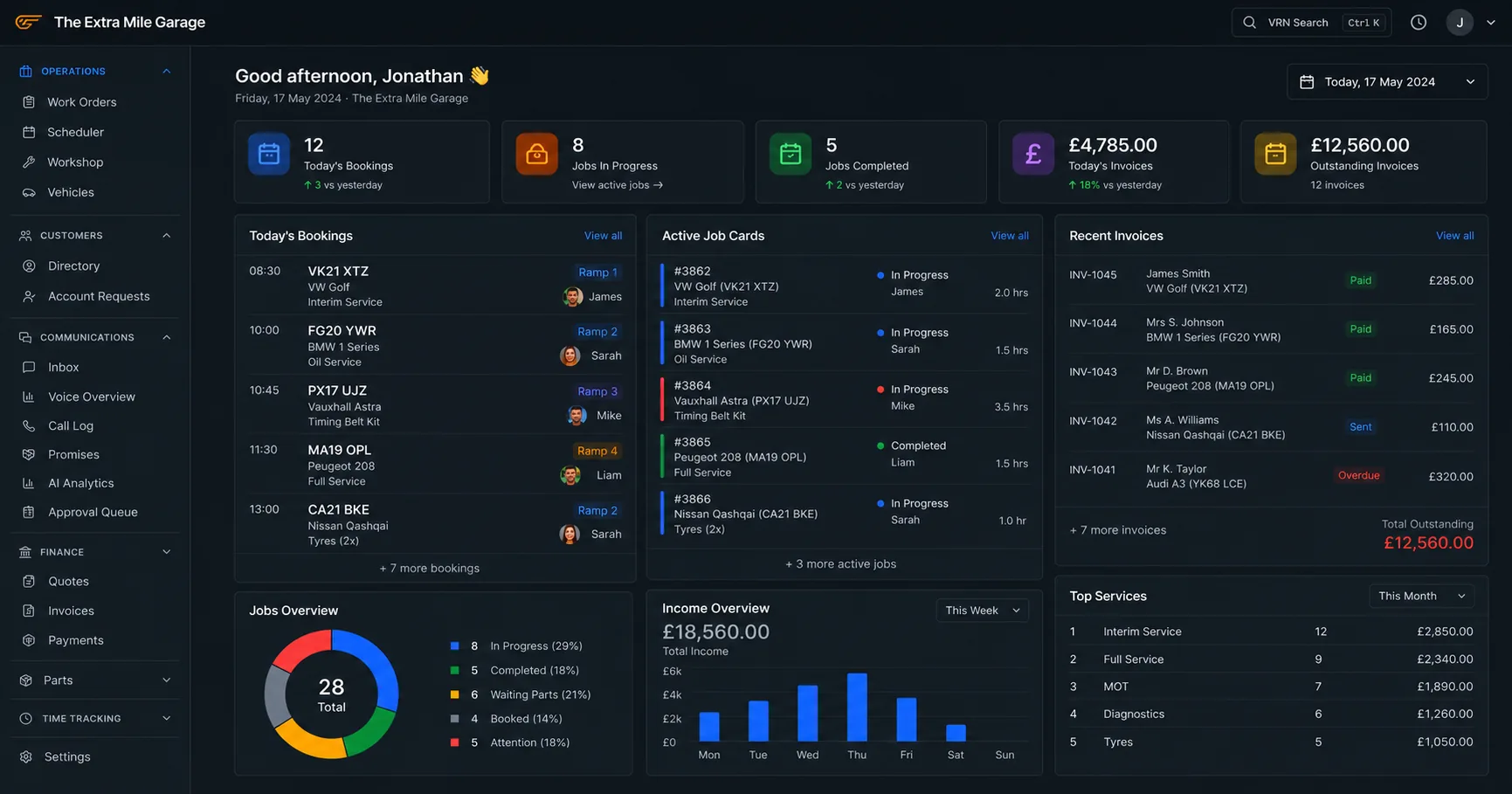
Americans would call the machinery behind this a CRM and shop management software. Customer relationship management is just your customer records used on purpose, and the software running your workshop already holds them: every number here, from booking sources to your average repair value, should come out of it without a spreadsheet.
Notice what the plan spends: almost nothing but attention. The reminders, the booking page, the profile and the reviews are either free or already inside tools you pay for anyway. That’s the honest shape of marketing for auto repair shops in 2026. Not louder adverts. Fewer leaks, an owned front door, and a map listing that makes the decision for people.
If the reminders-and-booking machinery is the part your garage is missing, that’s the bit we build. Have a look at pricing or book a demo and we’ll show you the reminder engine and the booking page running against a live diary. Either way, claim your Business Profile this week. It’s free, it takes half an hour, and it’ll help your auto repair shop more than anything else on this page.