AI Receptionist UK: A Garage Owner’s Guide to Choosing the Right One in 2026
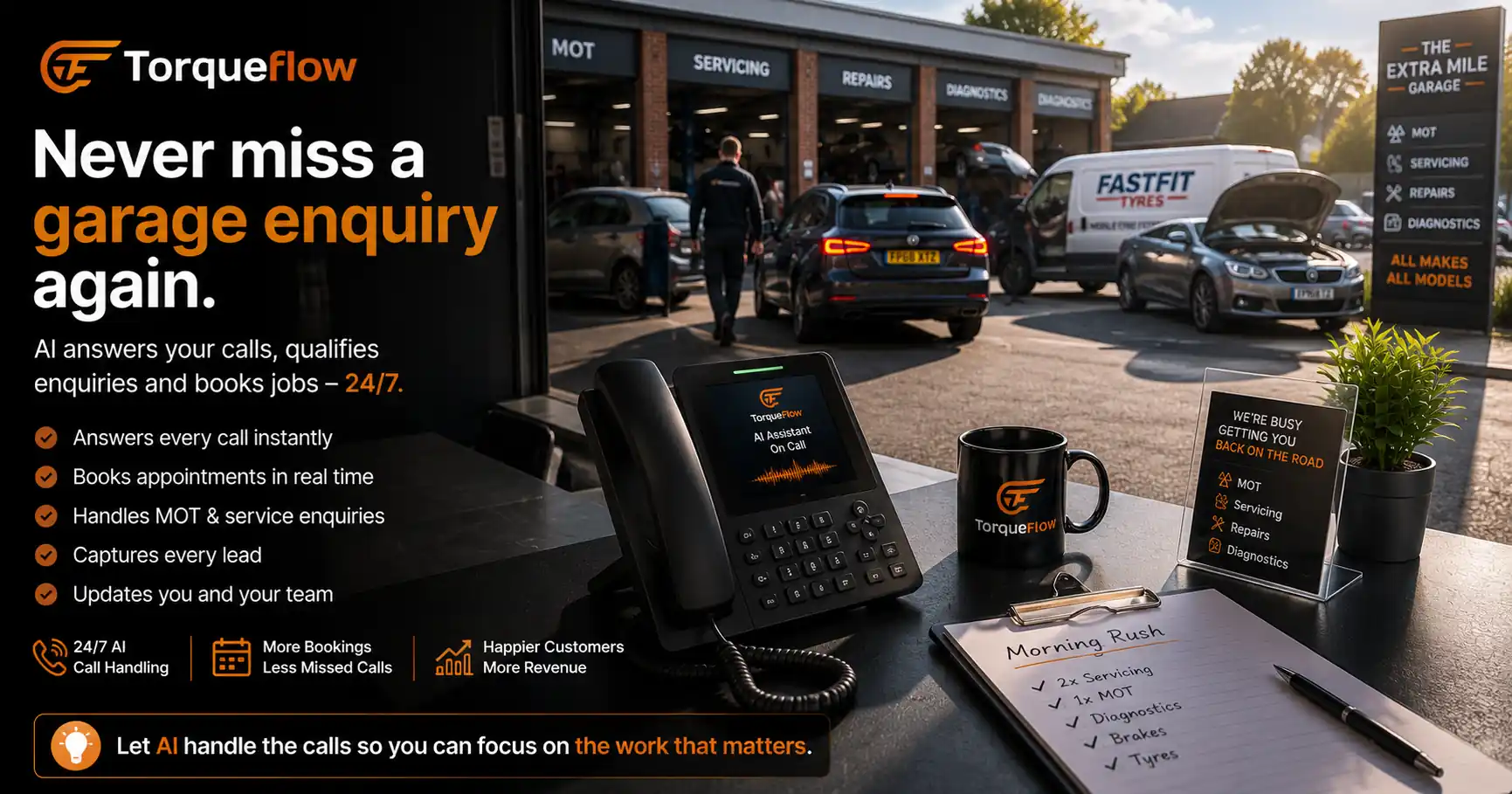
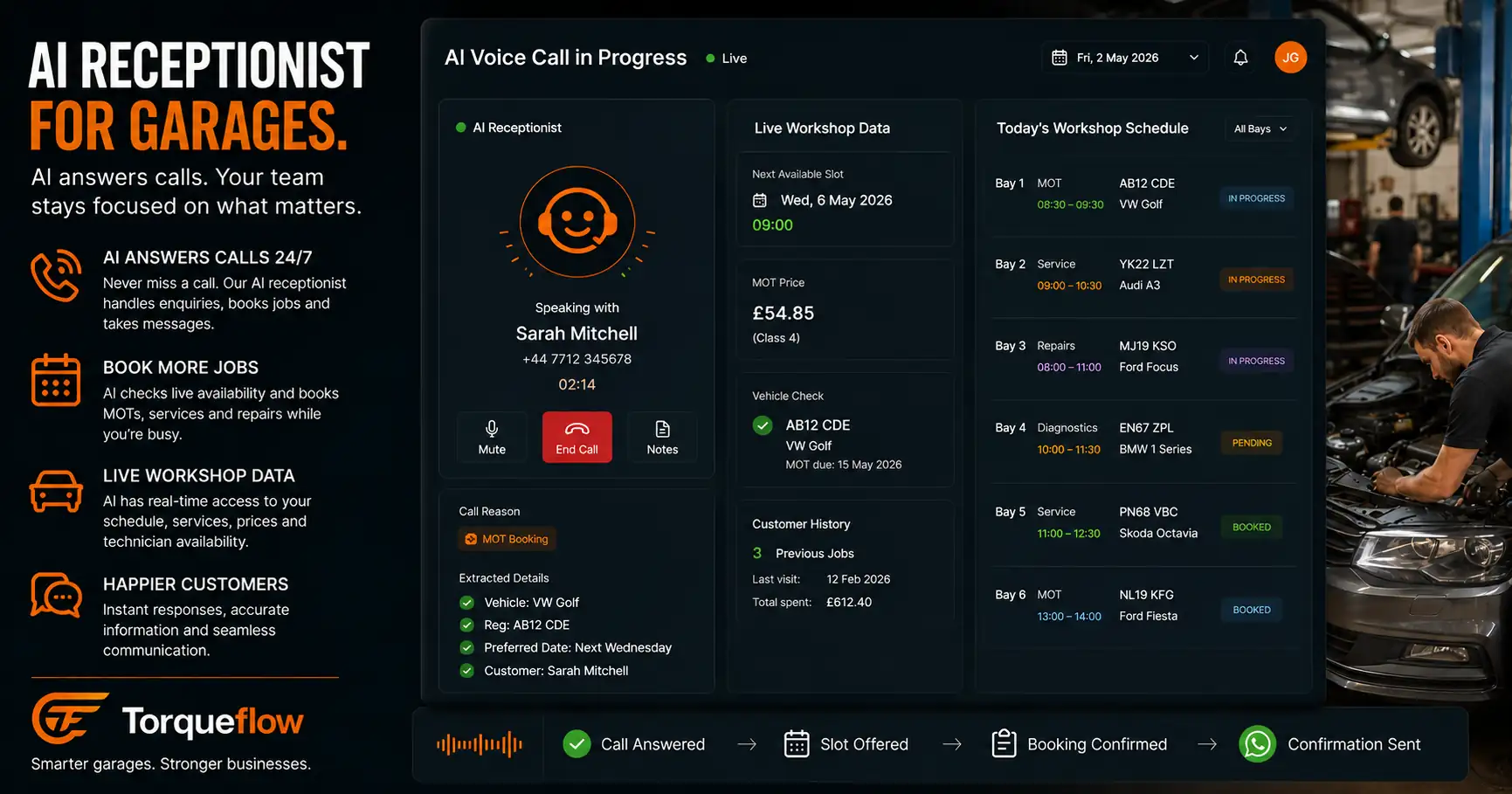
An AI receptionist answers your garage’s phone in a natural voice, works out what the caller wants, and books the job, quotes a price, or takes a proper message, 24 hours a day. Choosing one in the UK comes down to a single question: when the call ends, does the booking sit in your workshop diary, or does it arrive as a message somebody still has to type in?
This 2026 guide covers the UK AI receptionist market as a garage owner meets it. What the term means, the providers you’ll run into, the real costs, and the questions that separate a receptionist from an expensive answerphone. I build one of these systems, so I’ll declare the bias now and back the argument with specifics you can check.
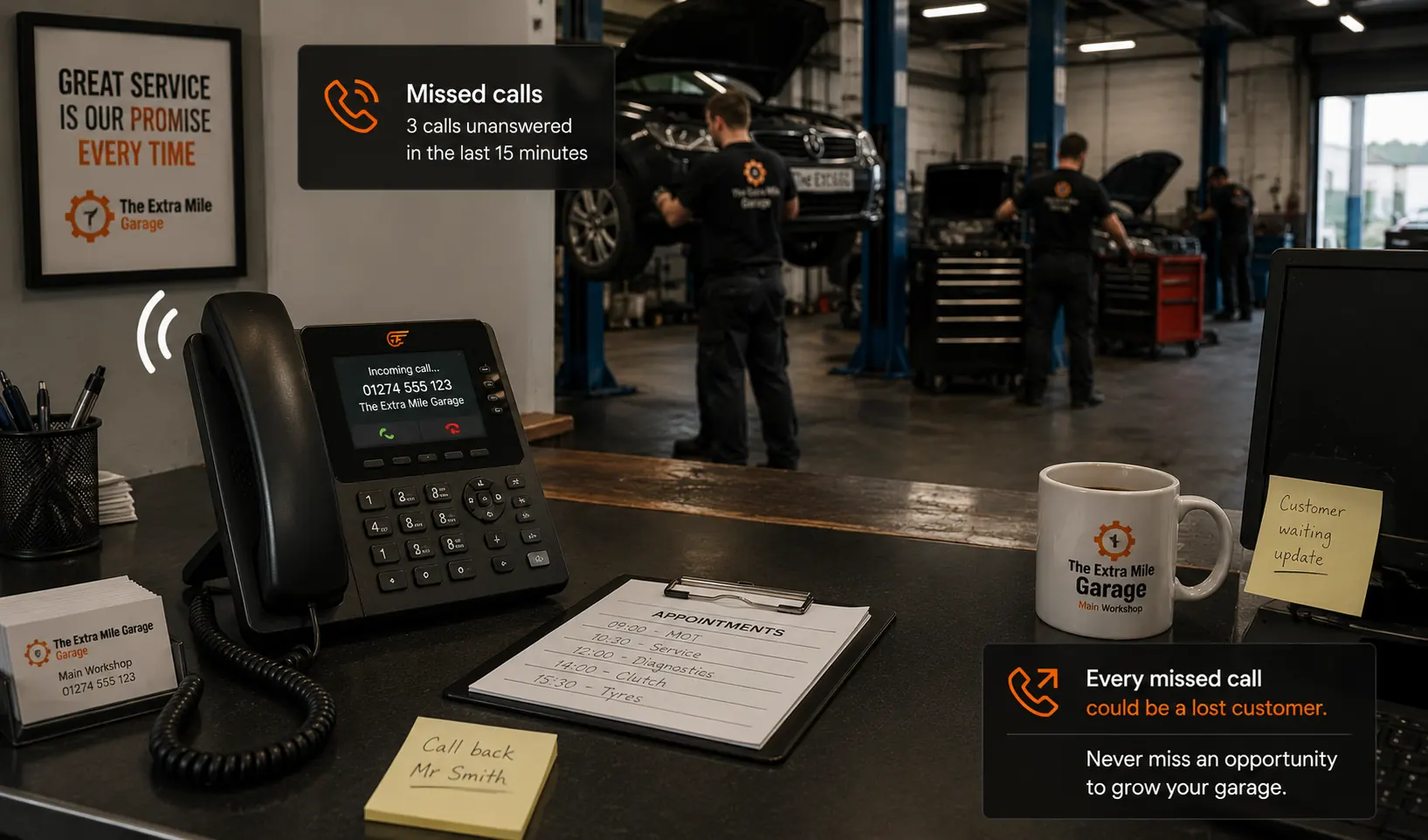
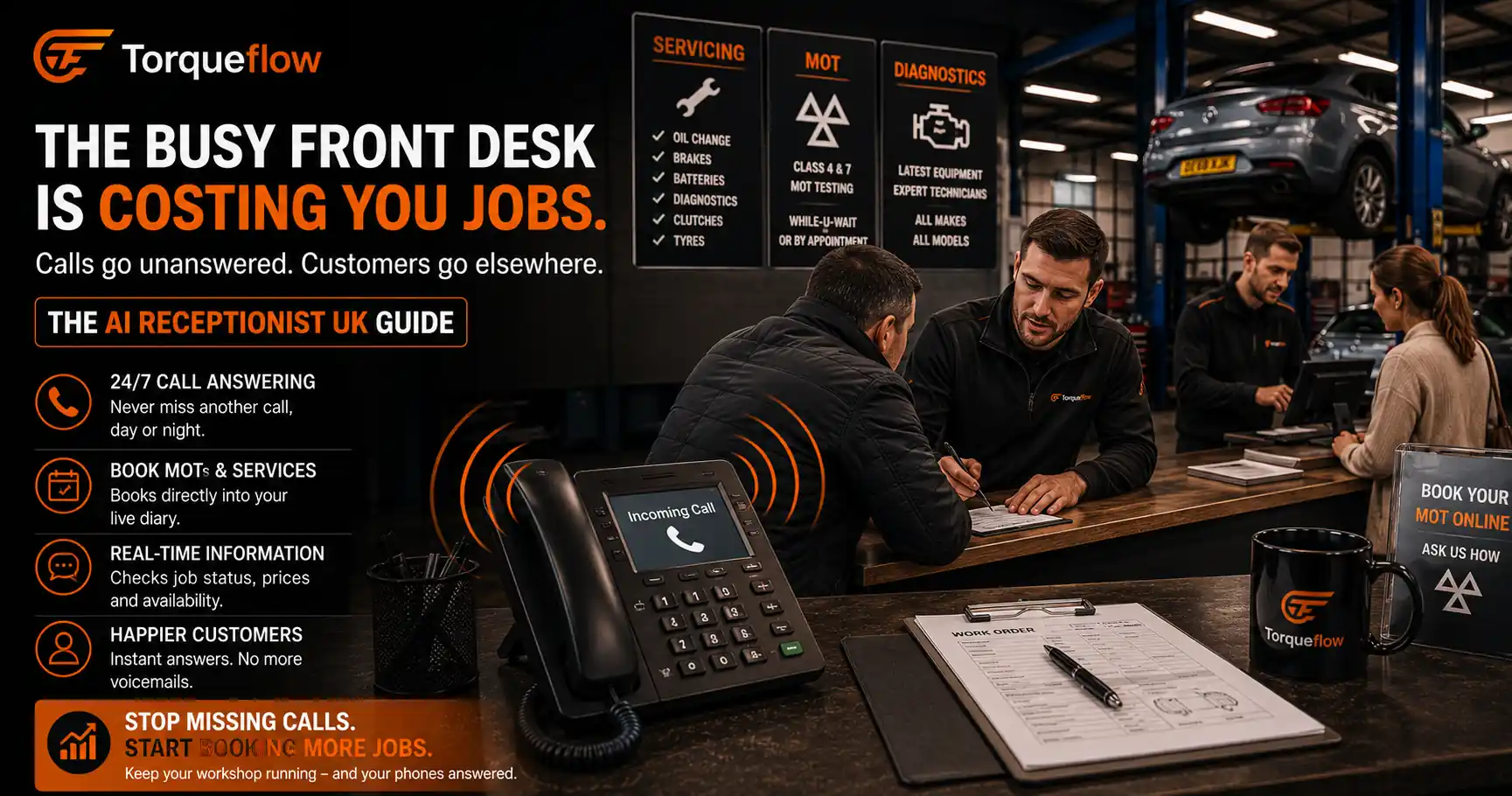
One number before the comparisons. Every provider in this market quotes a version of the same stat: garages miss roughly one call in four. Nobody audits that figure, but ring five garages at 8.45 on a Monday morning and count how many pick up. And a missed call in MOT season isn’t an inconvenience. It’s usually a booking that lands at the garage down the road.
The pitch is the same everywhere: answer every call. Where the products split is what happens after the call is answered. That’s where this guide spends its time.
AI receptionist vs virtual receptionist vs answering service
Three different products get sold under similar names, and the prices only make sense once you pull them apart.
A virtual receptionist is a human in a call centre answering as your garage. Telephone answering services have sold this for decades. An answering service works, and it’s priced like human labour: per call, climbing fast in March and September when MOT due dates cluster and call volumes spike.
An AI receptionist is software. It answers your business phone in a natural voice, understands the request, and acts on it. A modern AI receptionist doesn’t queue, so five simultaneous callers all get answered. And because nobody’s sitting in a call centre, the monthly cost is a fraction of the human version.
A hybrid AI service puts AI at the front and a human team behind it for anything the software can’t handle. Moneypenny is the best-known UK example. You pay somewhere in between.
Vendors invent new labels weekly: AI answerphone, AI call answering, AI virtual receptionist, AI voice agents. Ignore the label. Ask what happens to the booking.
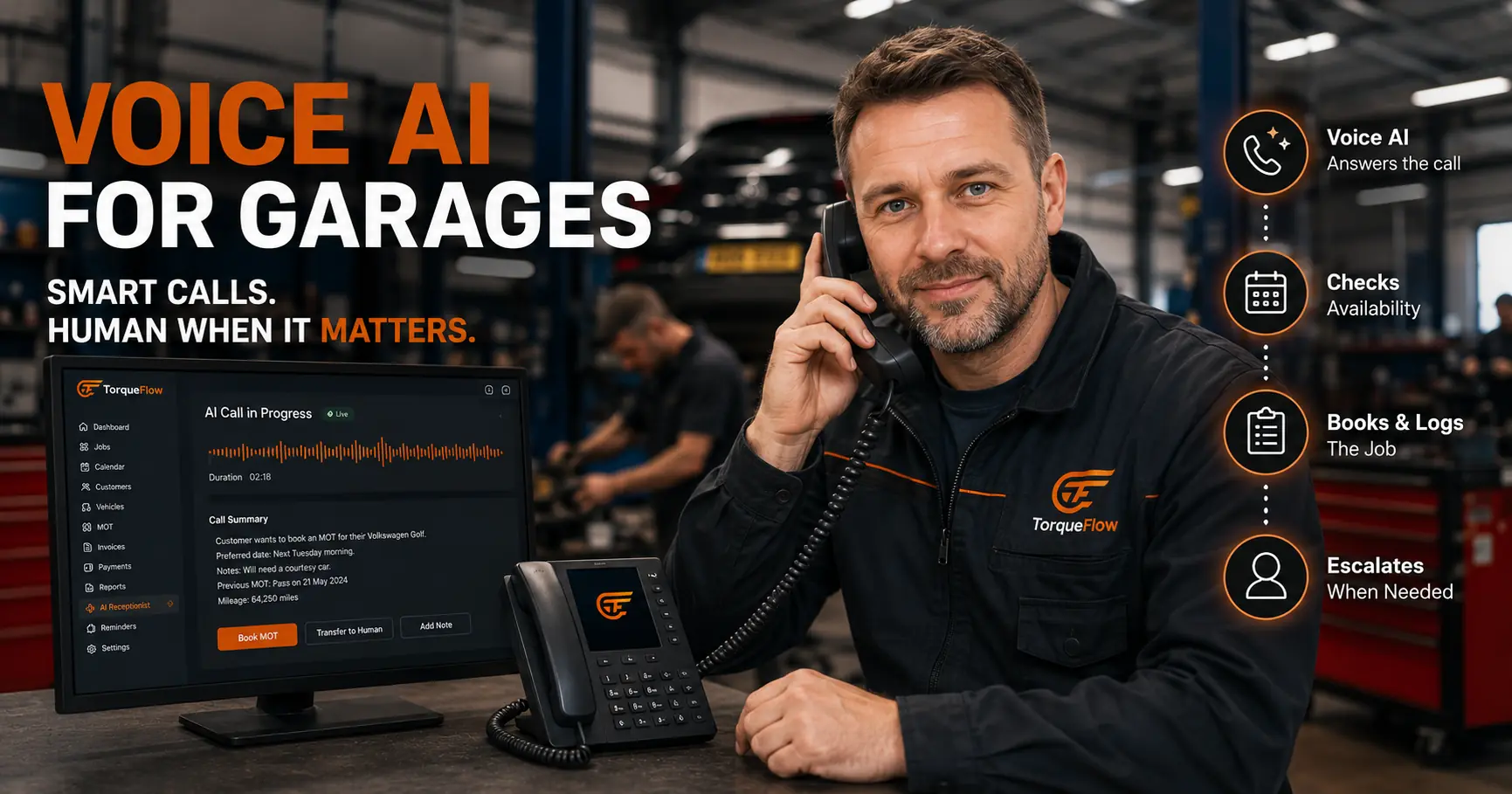
Two sibling reads if you’re earlier in the decision than this guide assumes. For the step-by-step of what one of these calls sounds like in a workshop, from “can I book an MOT?” through to the confirmation text, that walkthrough is here. And if your problem today is simply a phone that rings out while everyone’s under a ramp, start with why your garage phone keeps going to voicemail.
The AI receptionist providers a UK garage will actually meet
Search the category and you’ll drown. Round-ups ranking the best AI receptionists for UK small businesses in 2026 barely mention garages, because most of the market is built as an AI receptionist for small businesses in general, not workshops in particular. AI receptionist software sorts into four tiers, and the tier matters more than the brand.
Generic small-business tools. RingCentral AI Receptionist (sold through BT Business), Moneypenny’s AI offering, IONOS, Sophiie, and a long tail of AI voice agents pitched at UK SMEs, or “UK SMBs” as the American vendors put it. Prices run from £9.99 a month at the bottom to £150 and up. Each is a ready-made receptionist you can switch on in an afternoon: UK-based voices, a UK number, calls are answered within a couple of rings. But everything it knows about your garage is whatever you typed into a setup form. An AI receptionist aimed at every UK business from dentists to solicitors doesn’t know what a cambelt is, can’t see your diary, and drops its bookings into a CRM like HubSpot or a shared calendar, because its integration list is written for offices, not workshops. Decent lead capture. Not a front desk.
Trades-focused tools. A rung closer, built for plumbers, electricians and builders; ARROW is the visible name. They understand that a missed call costs a tradesperson the job, which is nearer your world than a dentist’s waiting room. But a garage isn’t a van and a quote book. It’s bays, MOT slots and a diary, and a trades tool doesn’t hold any of them.
Garage-specific bolt-ons. The automotive AI receptionist niche exists because the generic tier fails workshops. Electronic Receptionist is the loudest name in it and runs a 14-day free trial. ReceptionMate works the same patch. These handle garage calls properly: MOTs, services, “is my car ready?”. The limitation is structural, not quality. They sit outside your garage management software, so the call ends and the booking comes back to you as a notification, an email, or an entry in a separate calendar. Someone still keys it into the system that runs the workshop.
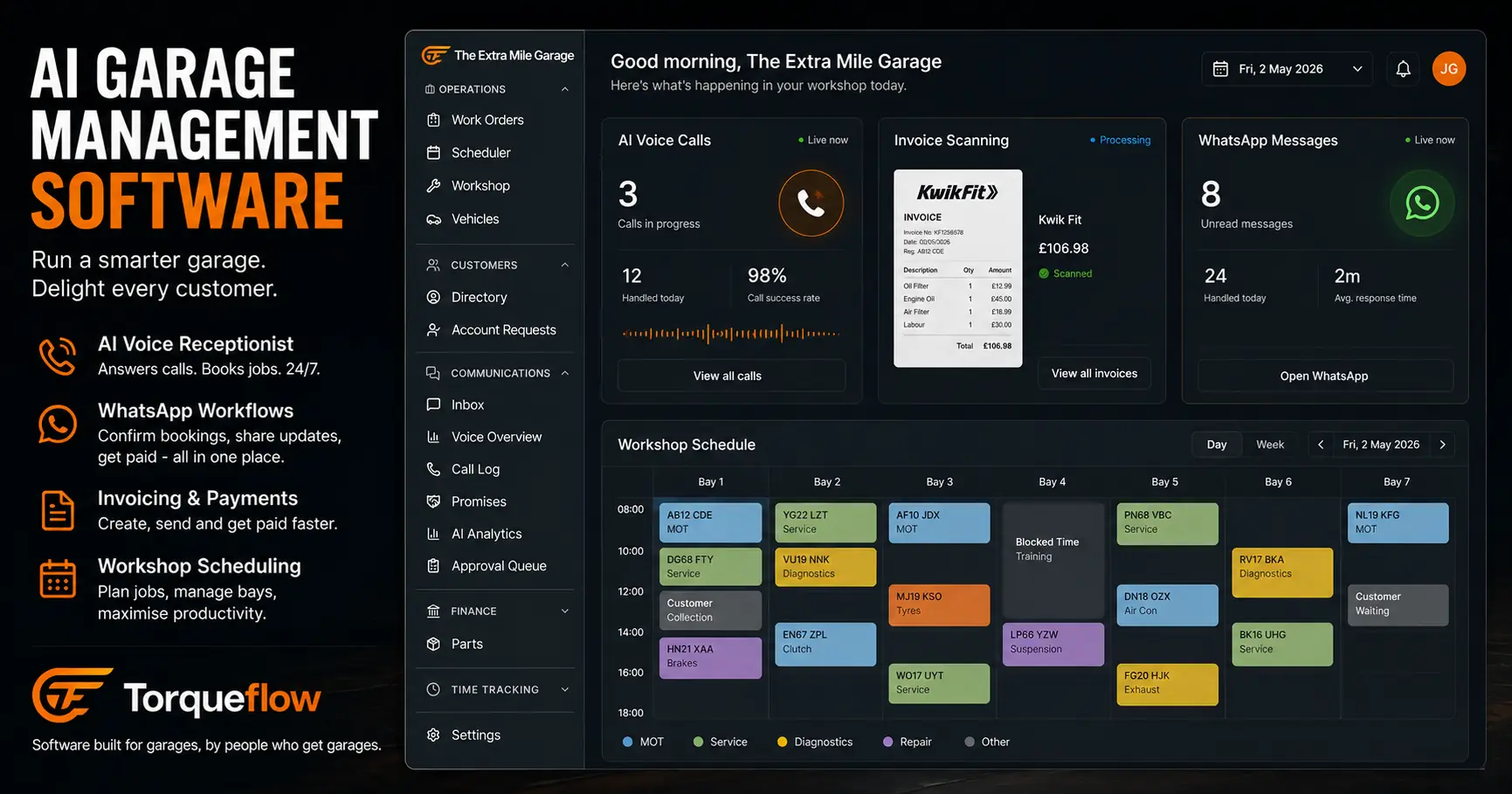
Built-in. The receptionist is a feature of the garage management system itself, working from the same live diary, price list, and customer records as everything else in the building. That’s the tier Torqueflow’s Voice AI sits in, and it’s the one I’d argue for. The next two sections are the argument. Judge it on the specifics.
How to choose an AI receptionist for a garage
Seven questions. Put them to every provider on your shortlist, ours included.
1. Where does the booking land? Anyone can claim to book appointments. Ask where the appointment goes. If the answer is “we send you the details” or “it syncs to a calendar”, you’ve bought a message-taker with better manners, and a calendar integration is not a workshop diary. The booking should be created in the diary you run the bays from, against a real slot, so the 10.30 it offers the caller genuinely exists.
2. Does it quote your real prices? A receptionist that answers “how much is an MOT?” with “someone will call you back” hasn’t removed the callback. It’s just delayed it. Torqueflow’s receptionist reads your service catalogue, so the caller hears your actual MOT price up against the DVSA’s £54.85 cap, a job priced from your labour rate is framed as an estimate with parts extra, and a service with no price set is offered as “pricing on request” rather than a made-up number.
3. Does it know who’s calling? When a returning customer rings, the AI receptionist answers already knowing their vehicle and history, which is what turns “when’s the Focus due its MOT?” into a ten-second call. Then ask the awkward follow-up: what about a complete stranger? Here’s our honest answer. A caller Torqueflow can’t match to a record gets availability and prices, and the AI captures their details, but it won’t create the booking until there’s a customer and vehicle record to hang it on. A tool that claims to book every stranger on first contact is also creating diary entries with no registration, no vehicle, and no history attached. Decide which failure mode you’d rather manage. For a business that lives on repeat trade, we think the answer is obvious.
4. What happens when it can’t help? Every AI has a limit. The difference is whether the handover to your human team arrives as “someone called earlier” or as an escalation with the recording, transcript, and a summary attached, sitting in a queue with a countdown timer so nobody forgets it. Commitments deserve the same treatment: if the receptionist tells a caller “we’ll text you the price within the hour”, something should be tracking that promise against the clock.
5. Can you hear every call? Recordings and transcripts aren’t a nice-to-have. They’re how you check the thing says what you’d want said before you trust it with your reputation. Torqueflow records and transcribes each call, keeps them searchable, and lets you set retention at 30, 60 or 90 days.
6. What happens to your number? You shouldn’t have to advertise a new number to get started. Look for a provider that ports your existing number, or hands you a new UK one, so calls are routed to the AI without your customers noticing anything changed.
7. Is it garage-aware, or just polite? An MOT booking has a deadline attached, so the receptionist should know the due date it’s booking against. And it should stand up to March and September, when the registration-plate cycle piles a year of tests into two seasons. Multi-site operators need one more check: each location should get its own voice, its own knowledge and its own diary, not one receptionist spread thin across the group.
Bolt-on or built-in: where the booking ends up
The bolt-on tier answers the phone well. That’s not the argument. The argument is the workflow after the call.
A bolt-on hands the outcome back to you, and the retyping begins. A built-in receptionist finishes the job instead: the booking becomes a work order in the diary, the work order becomes the job card, the job card becomes the invoice, one record end to end, with no integration between phone and diary to maintain because they’re the same system. When a customer rings at 4pm asking if the car’s ready, the AI reads the live job status and tells them. It confirms bookings by SMS and can send a payment link in the same message to take a deposit. After hours it keeps working while the workshop sleeps, and you decide how far it goes in the evenings: full service, bookings only, message taking, or plain voicemail.
Be clear-eyed about where the built-in advantage bites hardest: your existing customer base. The loop works best for the people already on your books, the returning MOT customer, the “is it ready?” caller, the regular who books the same service every spring. That’s most of a garage’s call traffic, and it’s the trade you can least afford to lose.
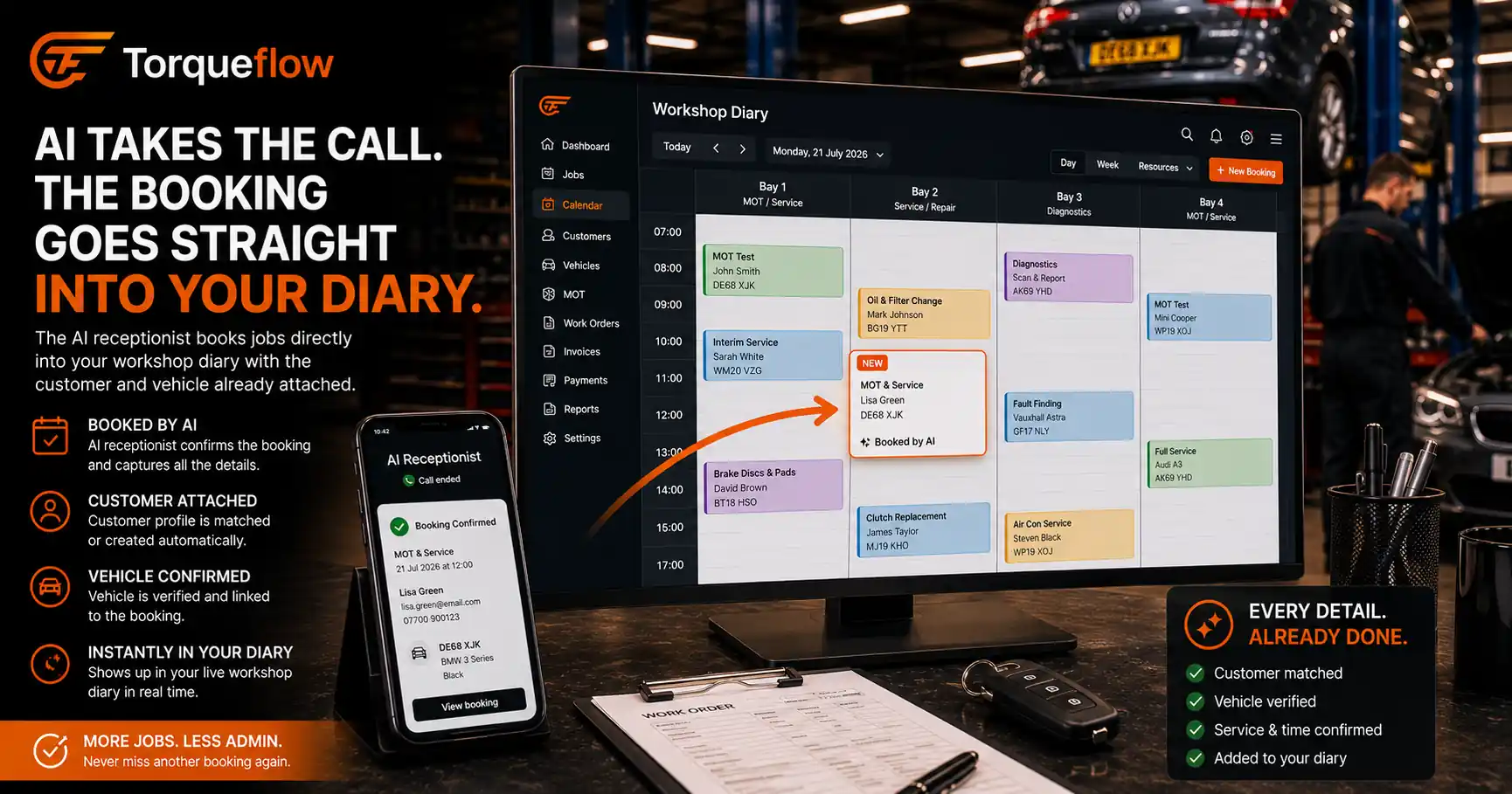
Which is why this is a garage software decision, not just a phone decision. An AI receptionist for UK garages that lives inside the system kills the retyping, the double-bookings, and the “who took this call?” mystery in one move. The best AI receptionist for garages isn’t the one with the cleverest voice. It’s the one wired into everything else your garage software already does. The phone is simply the first place AI running a garage’s admin pays for itself, and the best long-term buy reflects that.
How much does an AI receptionist cost in the UK?
Three pricing models dominate the market.
Per-call and per-minute. You pay for usage. Cheap in a quiet week, unpredictable for a garage fielding 40 calls a day in March.
Monthly bundles. A flat fee capped by the number of calls or minutes included, commonly 100 to 300 calls a month, with overage charges beyond that.
Flat monthly. Some providers advertise unlimited calls at a fixed price. Read what “unlimited” excludes.
Real monthly costs in 2026: garage bolt-ons and mid-tier generic tools mostly land between £50 and £150 a month. Hybrid services backed by people cost several hundred. For scale, a human receptionist on the desk 20 hours a week costs about £1,100 a month at the National Living Wage, before holiday cover. An AI receptionist is usually a tenth of the cost of the person it stands in for, which is exactly why this market got crowded so fast.
Built-in pricing works differently. The receptionist comes as part of the garage management system rather than as a separate bill, with credits covering the AI usage itself. Whether that beats a standalone tool depends on whether you want the rest of the system too, so do the sums against Torqueflow’s pricing with your own numbers: the standalone subscription plus the garage software you’d still pay for beside it.
Frequently asked questions
The FAQs below are the ones that come up in almost every demo.
Ring one before you buy one
Don’t judge any of this from websites, mine included. An AI receptionist is the rare software purchase you can evaluate with your own ears in under a minute.
So here’s the concrete next step. Book a demo and listen to Torqueflow’s receptionist take a call against a live diary: booking an MOT into a real slot, quoting real prices, recognising a returning caller by number. Bring the seven questions from this guide and put them to us first.