How AI Is Quietly Changing the Way UK Garages Operate
The AI that matters in a real garage doesn’t touch a spanner. It answers the phone at 8:40 on a Tuesday while both ramps are occupied, reads a supplier delivery note into stock before the van door shuts, and sends the MOT reminder nobody had time to type. The robots-doing-diagnostics future you hear about at trade shows is mostly still a keynote. In 2026, the back office is where artificial intelligence is actually working in the garage industry, and it’s working now.
Every trade show in the industry now has an AI talk. The slides are always the same: a robot arm, a dashboard predicting brake wear from telemetry, a claim that diagnostics will be automated within five years. The garage owners in the audience nod politely, go home, and carry on running the workshop off paper diaries and a phone that rings out.
I don’t blame them. The conference version of AI has almost nothing to do with independent garages. The six-bay workshop in Stockport, the two-man unit in Plymouth: most of the people on stage don’t understand what their Tuesday morning at the counter looks like. But while everyone argues about whether a machine will ever do an MOT, a quieter change has already happened. It started with the phone.
The best AI in a garage answers the phone
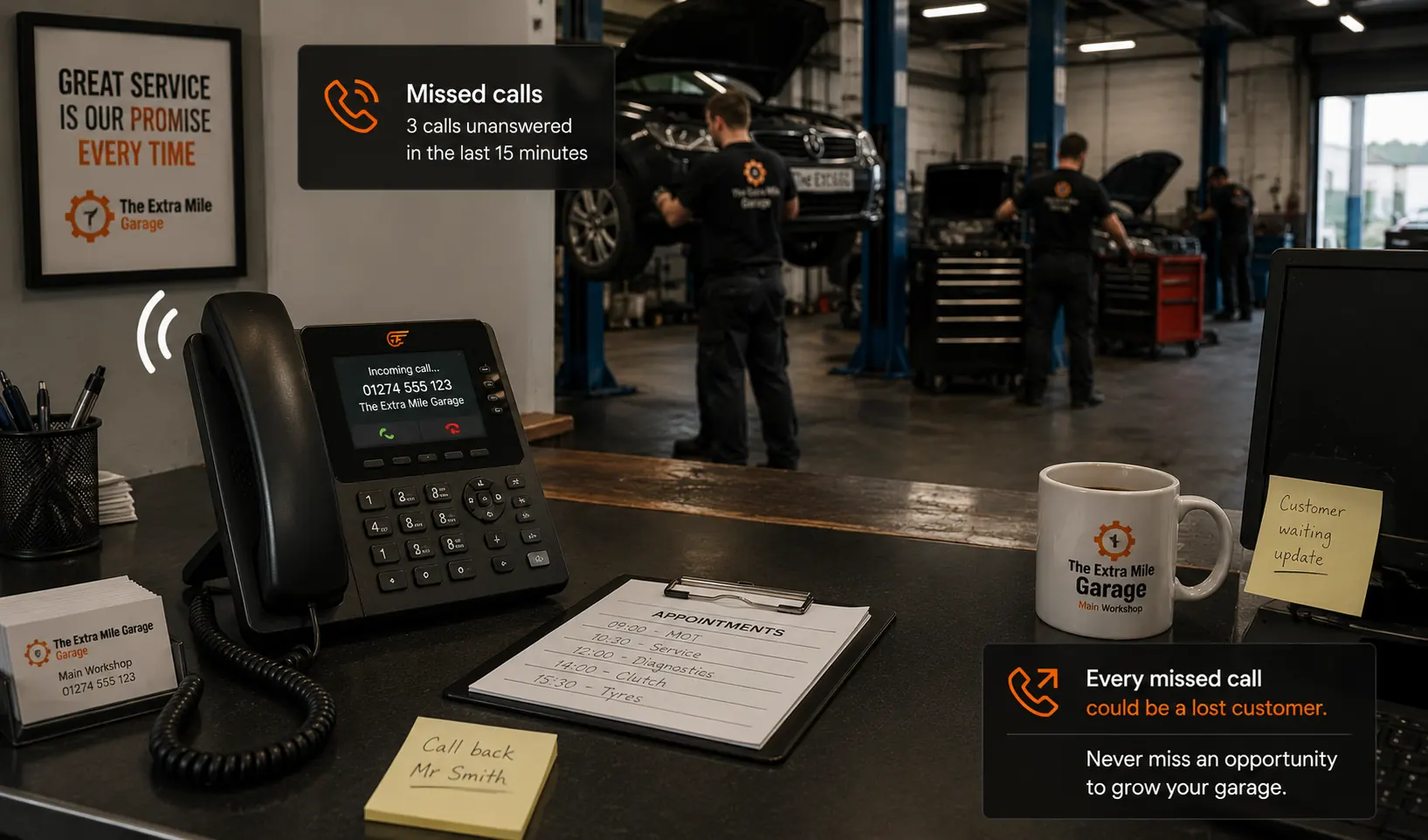
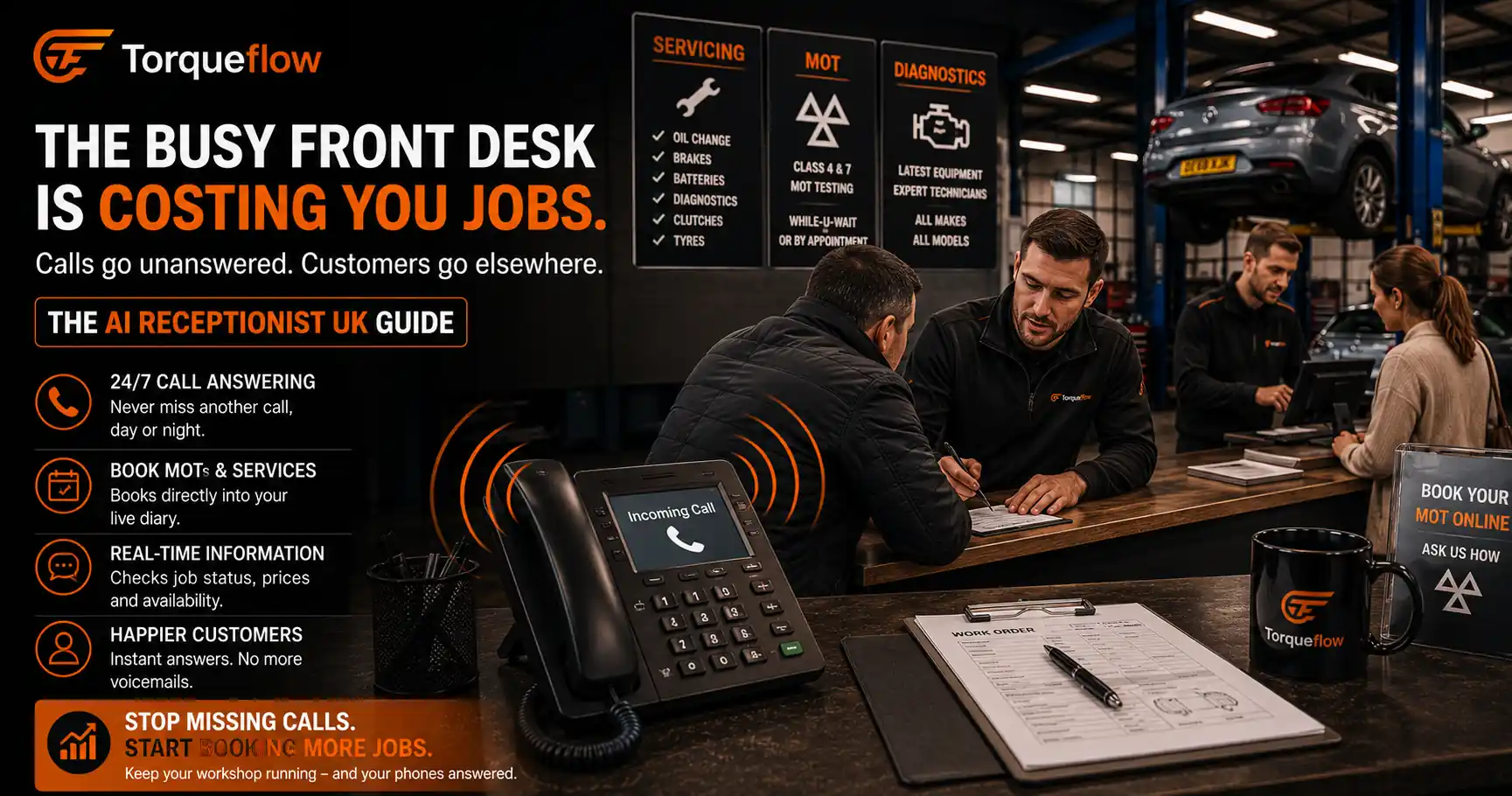
Talk to any garage owner about lost work and the conversation lands on the phone within a minute. The 8:40am rush, when every parent on the school run calls at once. The weeks in March and September when the diary fills and the calls double. Both technicians under cars, the owner halfway through a brake job, and the phone ringing out at the counter.
Voicemail is where bookings go to die. Most drivers won’t leave a message; they call the next garage on the list. That’s been true for twenty years, and for twenty years the only fix was hiring someone to sit at the desk.
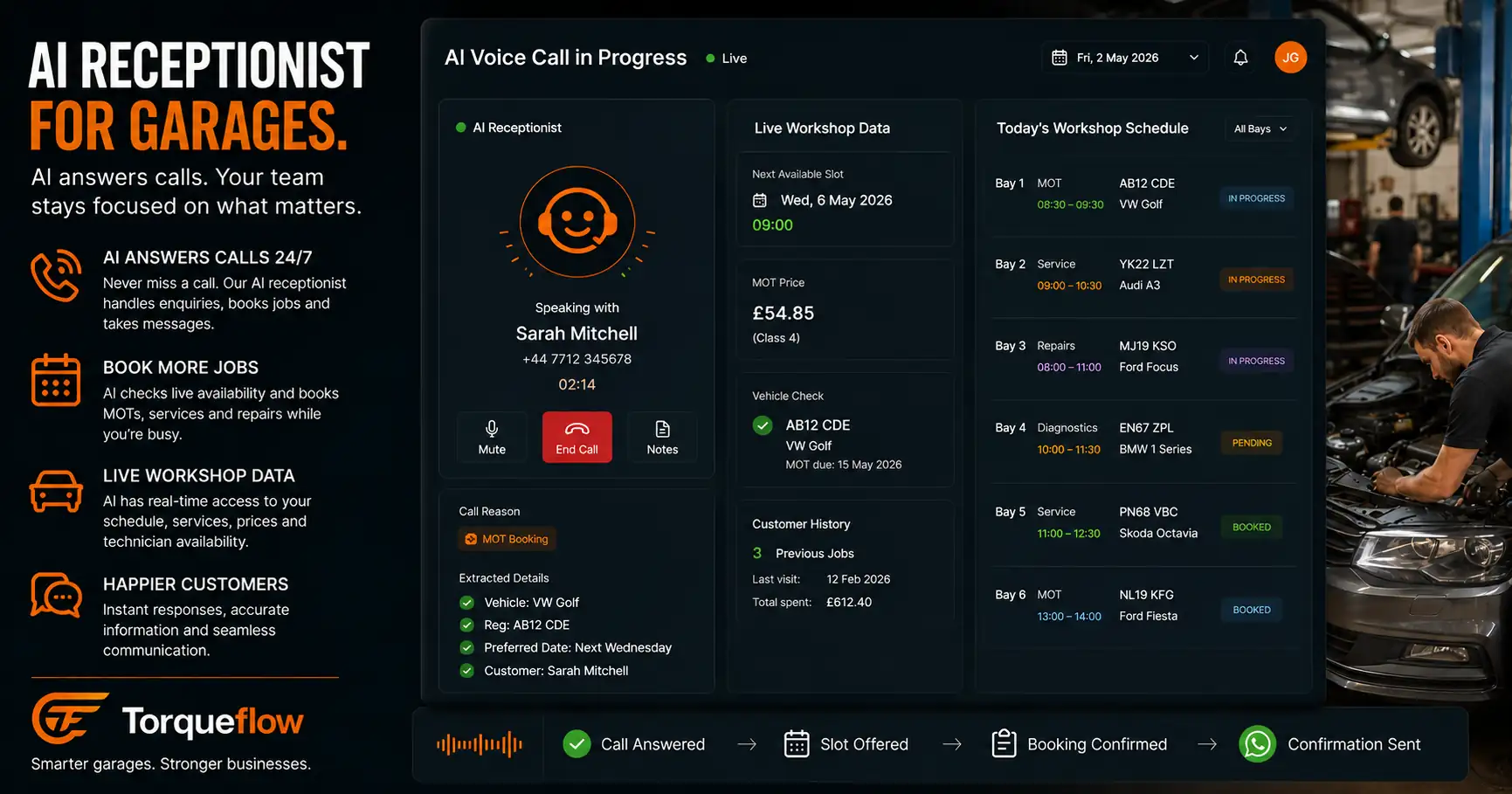
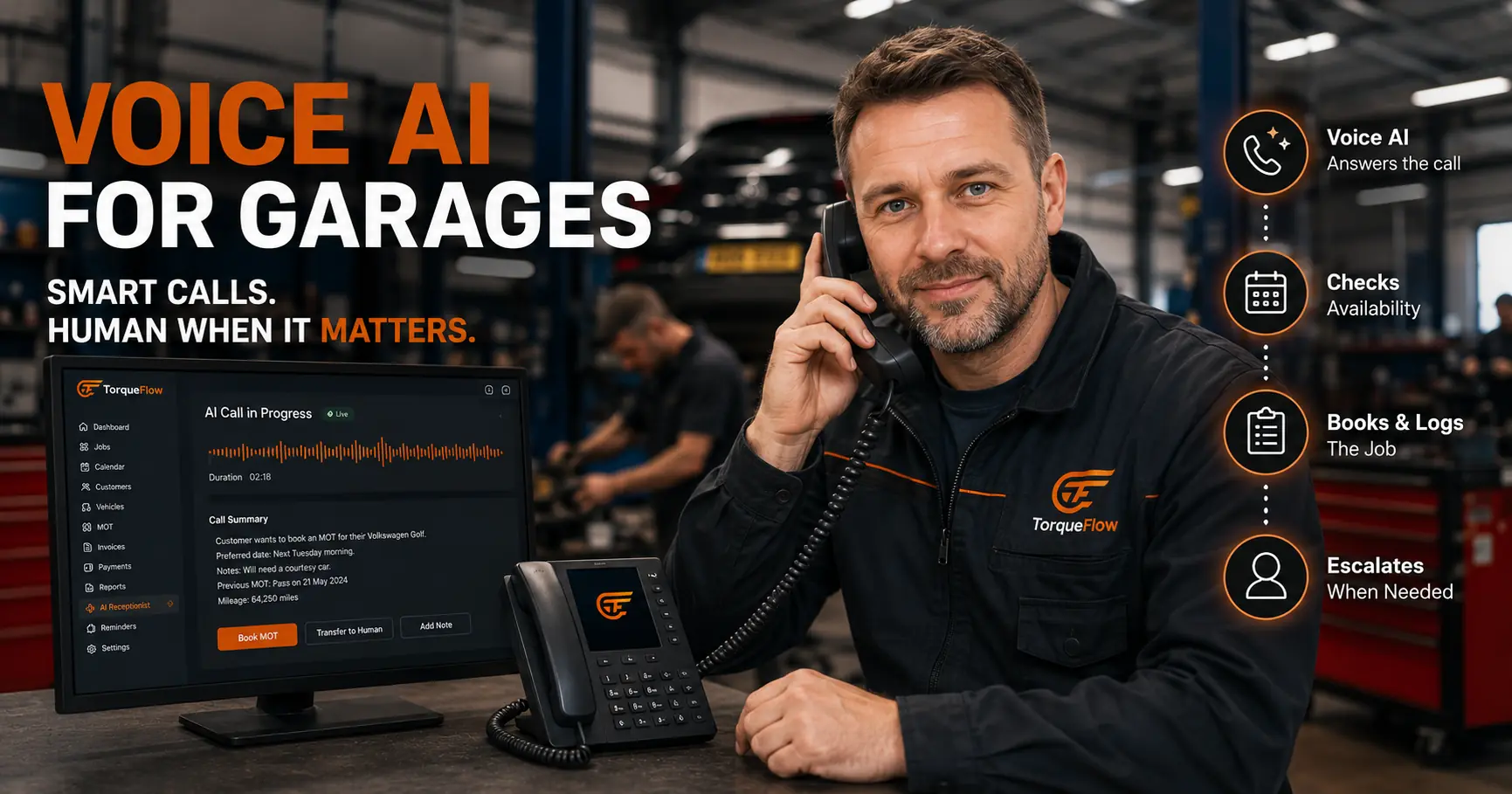
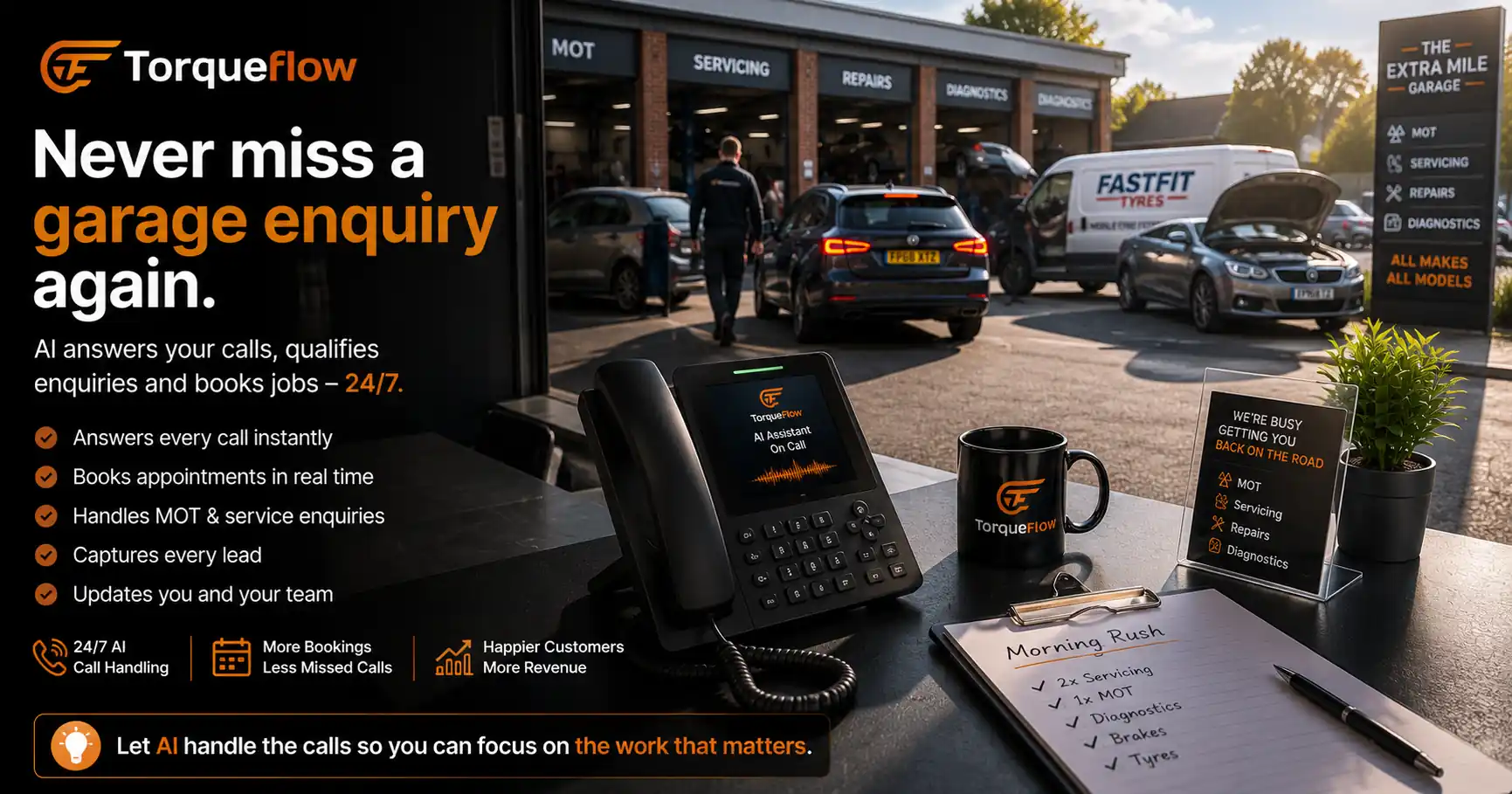
So that’s the first job AI took in the garage, and almost nobody noticed it happening. An AI receptionist answers the inbound call, checks the live diary, offers the caller a time, and puts it in front of whoever confirms it. It does it reliably, at 8:40am and at six o’clock, which is the entire job description.
And let’s be honest about the experience: most callers can tell they’re not talking to a human. It doesn’t matter. The comparison isn’t human-versus-AI. It’s AI-versus-voicemail, and voicemail loses every time. Customer service isn’t ruined by a synthetic voice. It’s ruined by no answer at all.
Read more about why your garage phone keeps going to voicemail →
Paperwork that reads itself: invoices, estimates, admin
The second change is less visible than the phone but probably worth more.
A mobile mechanic told us recently that roughly one job in five never got invoiced. Not because the work wasn’t done, but because the paperwork happened at 9pm at the kitchen table, and some evenings it didn’t. One job in five. A full week of work, a day of revenue given away to typing.
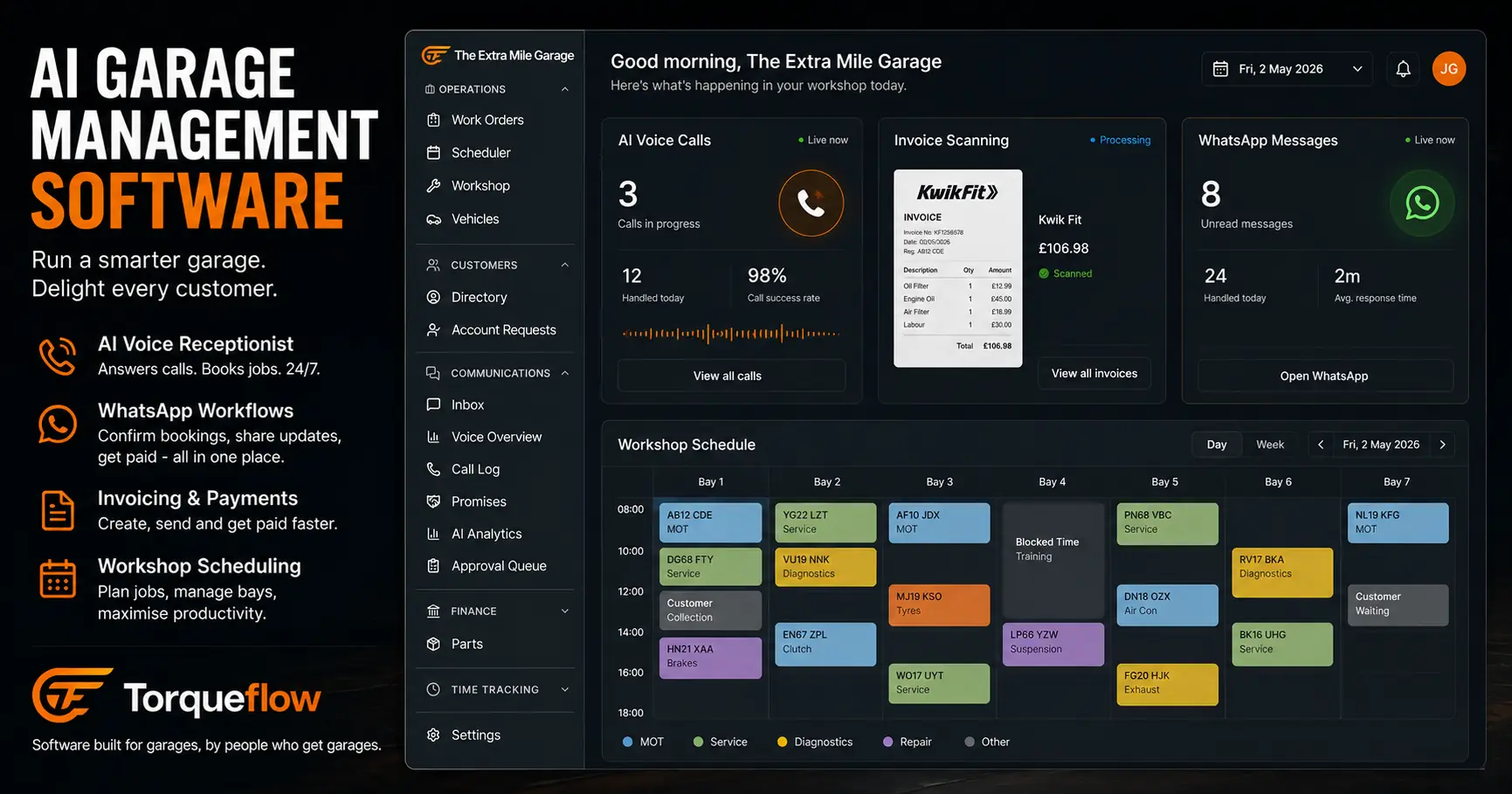
This is where AI earns its keep without anyone calling it AI. Photograph the supplier’s delivery note and the parts land where they belong: some into stock, some onto the jobs that were waiting for them. Scan the supplier’s invoice and every line comes off the page instead of out of someone’s evening. The customer’s invoice is built from the work order, not from memory, and a finished job with no invoice on it sits on a list until somebody raises one. That list is the whole cure for one job in five. And the system sends reminders because it read the MOT date from the DVLA record, not because someone remembered to check a spreadsheet on a Sunday night.
None of this is glamorous. That’s rather the point. The hours a garage loses aren’t lost to hard problems; they’re lost to repetitive admin. Estimates retyped, customer records updated by hand, the warranty paperwork, the manual copying between systems that don’t talk to each other. These are the tasks nobody bills for. Typing is exactly what this generation of AI tools was designed to automate, and reducing admin is where the productivity gain genuinely lives. A person still checks and confirms at each step, and should. The point isn’t the technology. It’s the hour a day it gives back.
See how AI invoice scanning works →
The 9pm question: customer communication after hours
There’s a third leak, and it’s newer than the other two.
Customers stopped ringing during business hours years ago. They message. A WhatsApp at 9:15pm asking how much an MOT costs. An email on Sunday afternoon asking if you can fit a clutch on a 2018 Transit this week. The driver sends it when the problem occurs to them, which is rarely between eight and six. Customer communication is now half the job, and it’s the half nobody trained for.
Nobody expects a garage to staff a night desk. But the customer who messages three garages at 9pm books with whichever one responds first, and “first” usually means “before breakfast”. An AI that answers the easy questions immediately, quotes the price from your own list, tells a regular where their car’s up to and leaves anything else for the team with a summary waiting in the morning, is first in the queue without anyone losing an evening. A regular who wants to book there and then gets their portal link in the reply, and the portal puts them in a real slot on the spot.
The judgement rule applies here too. The AI answers “how much is an MOT?” because that has one correct answer. It doesn’t answer “my brakes feel spongy, is it safe to drive?” That goes straight to a human. Knowing which is which is the whole craft of doing this well.
What AI tools shouldn’t do in a garage
Here’s the part the AI-first software crowd won’t say: there are jobs in a garage AI should stay away from, and the trade’s scepticism about them is correct.
AI shouldn’t write your advisories. It shouldn’t diagnose a braking fault from a photograph. It shouldn’t decide whether that corroded brake pipe is an advisory or a fail. Those calls carry legal weight and they’re backed by a technician’s judgement, insurance, and reputation. A garage that lets a language model make safety calls deserves the lawsuit it eventually gets.
So every claim in this article comes with the same caveat: AI output is a suggestion, not a verdict. It’s a copilot for the front desk, not a chief examiner. AI for admin, humans for judgement. The technician who’s done ten thousand MOTs is not the bottleneck in a garage business. The unanswered phone is the bottleneck. The uninvoiced job is the bottleneck.
When a software vendor tells you AI will transform your operation, ask them precisely which jobs it does. If the answer sounds like it replaces your technicians, walk away. If the answer sounds like it replaces the evening paperwork, that’s the real thing.
Why the change is quiet
There’s a reason nobody’s noticed this happening: the result of good back-office AI is an absence.
The phone that doesn’t ring out doesn’t announce itself. The invoice that went out on time looks like nothing. A garage running this way doesn’t look futuristic; it looks calm. The owner is on the tools or talking to a customer instead of triaging voicemails. Each improvement is invisible on its own. Together they compound into a different kind of operation.
Customers notice the absence too, in their own way. They got an answer when they called. The reminder arrived by text a month before the test, not as a letter two days after it expired. The photos from the health check were on their phone before they’d finished their coffee. There’s no learning curve and no app to install; it doesn’t read as “this garage uses AI”. It reads as “this garage has it together”, which is worth more.
One pattern separates the tools that deliver this from the ones that don’t: the working ones are purpose-built for the trade and woven into the garage management software you already run, not a generic chatbot bolted onto a website. The integration matters more than the intelligence. An AI receptionist without the live diary is a polite answering machine. With it, the AI can offer a caller a Thursday morning that genuinely exists, and the only thing left for you is to say yes.
That’s the gap that will open between garages over the next few years. Not clever versus stupid, and certainly not robots versus humans. It’s the compounding difference between a business that loses ninety minutes a day to admin and one that doesn’t. Ninety minutes a day is a full working day every week.
FAQ: AI for garages
Where to start
Not with a strategy document. Pick the leak that costs you most, which for nearly every garage is the phone, and fix that one thing. If you want the explainer version of what’s available, the guide to AI garage management walks through the tools in plain English.
And if you’d rather just hear what your own missed calls are costing, that’s a 30-minute conversation. We’ll show you the voice AI answering a real booking call, live.
Torqueflow puts the AI where it belongs:
the phone, the paperwork, the reminders.
Your technicians keep the spanners.