Switching from Garage Hive: What Transfers, What Doesn’t, and What It Costs
Switching from Garage Hive takes about a week, costs at most one overlapping month on the rolling contract, and your data comes with you, because nearly every list in the system exports to Excel. That’s the short answer. The long answer, for UK independent garages weighing the move, covers what transfers, what staying actually costs, and the things Garage Hive still does better than its alternatives.
Let’s establish what this isn’t. It isn’t a hit piece. Garage Hive is the system UK garages get told to buy: strong community, serious depth, more testimonials than any other garage management system in the UK. Built on Microsoft Dynamics 365 Business Central, it’s one of the most capable pieces of UK garage management software on the market. Multi-site operations love it. Data-driven owners with a Power BI habit love it. The community around it is real and worth something.
But capability has a cost, and the cost is attention.
Why garages think about switching from Garage Hive
The pattern we hear from switchers is consistent. They’re garage owners running an independent garage of two to six bays. They chose Garage Hive for the depth, and two years in they’re using maybe a fifth of it. The reporting suite goes unopened. The dashboards show numbers nobody acts on. And the day-to-day workshop management, bookings, jobsheets, invoices, reminders, carries a system built for a much bigger workshop size.
Because it sits on an ERP, Garage Hive behaves like one. Configuration changes that feel like they should be a settings toggle often mean a support ticket or a session with someone who knows Business Central. That’s not a flaw. It’s the nature of the platform. An ERP rewards a business that has someone who enjoys running it.
And the licensing is per-user. Every admin or service advisor is a Full User, technicians are Lite Users, and each one adds to the monthly bill. A growing team means a growing subscription, independent of whether you’ve added a single bay.
There’s a moment that crystallises it. The owner wants to change a labour rate, or add a new booking type, and twenty minutes later they’re reading a Business Central help article while a customer waits at the counter. Multiply that by a year.
If you’re the multi-site operation with a systems person, none of this argues for leaving. Stay. For everyone else, the question is whether the depth you’re paying for is depth you use.
Read the full Torqueflow vs Garage Hive comparison →
Garage Hive pricing: what staying costs
Garage Hive doesn’t publish UK pricing. You get a quote. That makes comparison hard, but their own published Irish price list (November 2022, so treat the figures as indicative rather than current) shows the shape of it: Core from €135/month plus VAT, Pro from €265, Enterprise from €475, with system setup from €275 as a one-off. Extra Full Users were €83 per user per month, Lite Users €36. The Autodata integration ran €58-171 per location per month depending on tier, and the built-in accountancy module was €48/month on top.
Two things matter in that structure. First, the per-user model: your cost scales with headcount, not workload. Second, the add-on stack: Autodata, accountancy, vehicle sales, and multi-location capability all sit outside the headline price.
There’s also metering. Plans include monthly allowances (300 SMS, 150 VRM lookups, 200 postcode lookups on the published list) and per-unit charges beyond them. Smaller numbers than Techman’s credit model, but the same principle: the basics are counted.
When you compare against any alternative, compare all-in against all-in. Headline price plus users plus add-ons plus units, against whatever the other system charges for the same workload.
The good news: leaving Garage Hive is not a trap
Some competitor comparison pages imply you’ll be trapped in a three-year contract. As far as Garage Hive’s own published Terms of Service go, that’s wrong, and it’s worth being accurate about.

The standard agreement is a one-month rolling contract. You can cancel at any time by signing the cancellation form, you pay to the end of the current month, and that’s it. The exceptions are the add-on commitments: Autodata is billed quarterly and Microsoft 365 licences annually, so those run to the end of their period. No early-termination fee, no lock-in.
Your data is also safer than the anxiety suggests. Garage Hive keeps it on secure cloud storage for three months after termination, so cancelling doesn’t vaporise your records. And before that even matters, you should export your data in full while the account is live, which brings us to the genuinely good part.
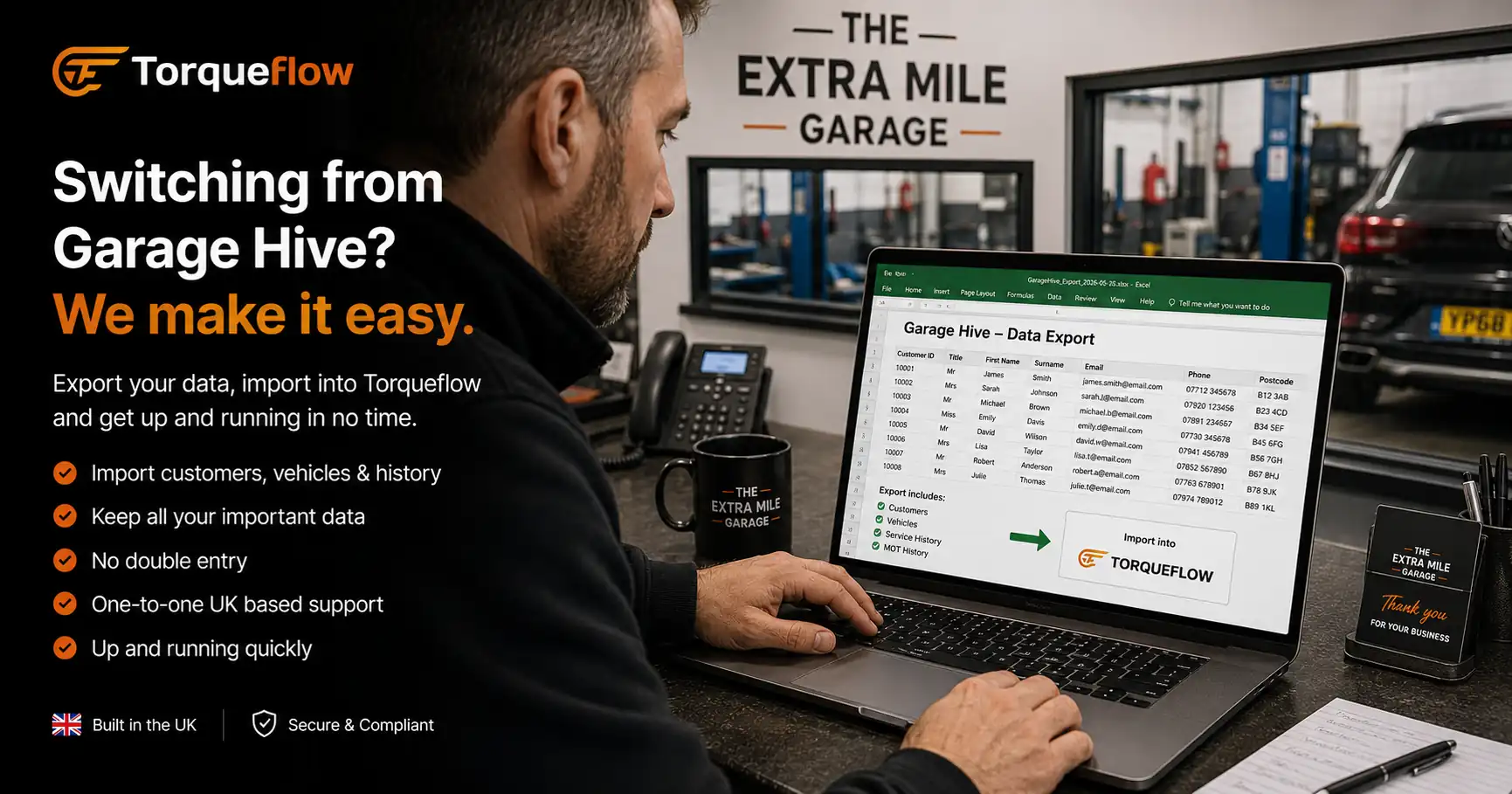
Because Garage Hive is built on Microsoft Dynamics 365, data export is a strength, not a concession. Advanced filtering and exporting is included in every plan, and nearly every list view exports to Excel. Customers, vehicles, jobsheets, invoices: a few clicks each. Plenty of legacy garage software makes you beg for your own records. Garage Hive hands them over cleanly. Credit where due.
What transfers to the new system
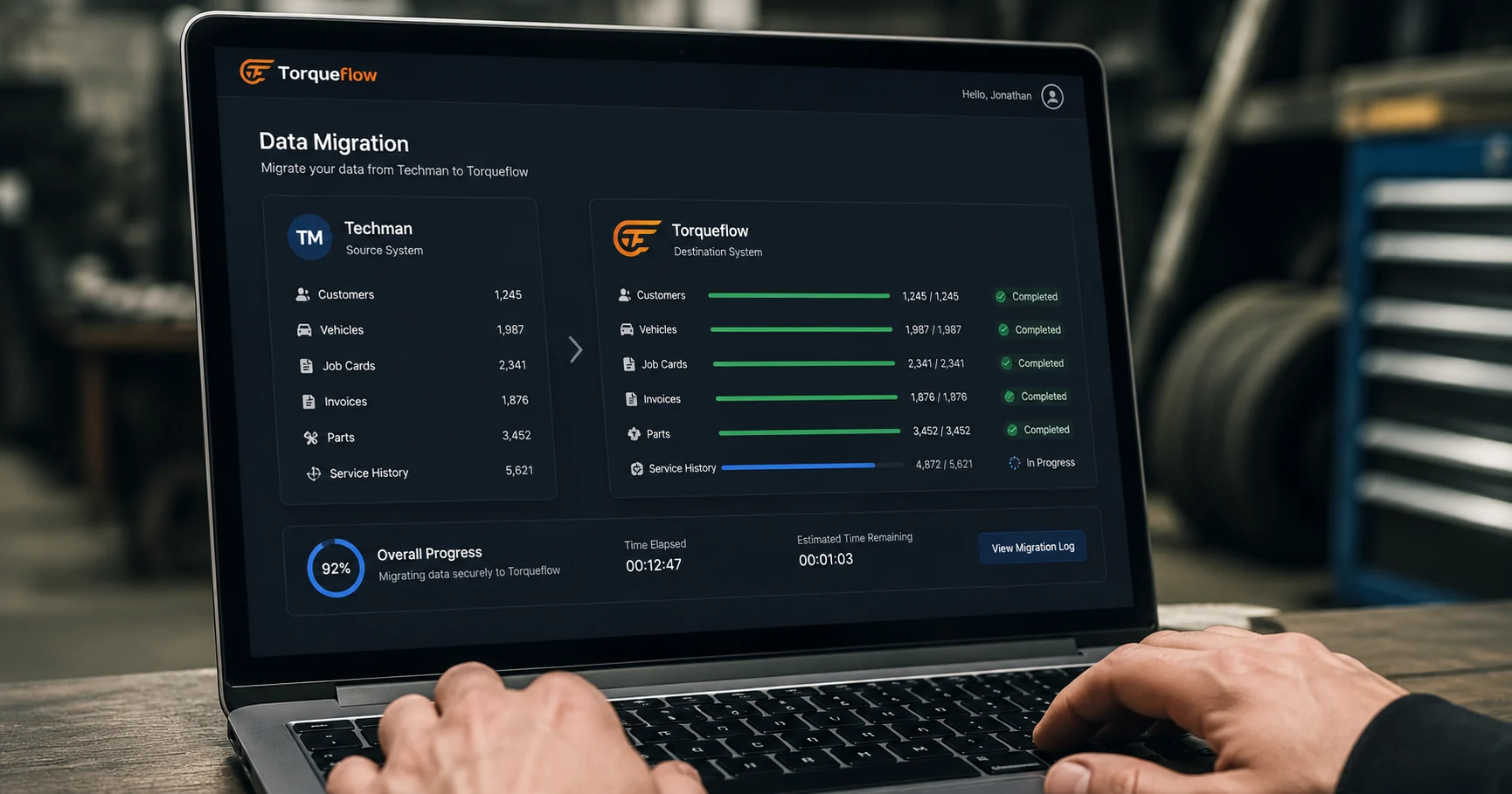
Customer and vehicle data. Names, contact details, registrations, makes, models. Export to Excel, import to the new system. Torqueflow’s import auto-detects what each CSV or Excel file contains, previews everything before committing, and supports rollback if something looks wrong.
Invoice and job history. Completed jobsheets and invoice records import so your audit trail and customer history survive. This is what lets service reminders and MOT reminders work from the first week: the new system knows what was done and when.
MOT and service dates. These travel with the vehicle records, and anything DVLA-derived gets re-fetched by the new system’s own DVSA MOT integration the first time each vehicle is opened.
What doesn’t transfer: the platform-specific layer. Power BI dashboards, custom report packs, and personalised document layouts are Business Central artefacts; they stay behind. Your Autodata subscription is a separate service and keeps working alongside whatever you move to. Connections to parts suppliers (GSF Car Parts, Dingbro, and the rest) are integrations, not data, and reconnect to whatever the new system can integrate with. If supplier integration is core to your day, ask the new provider exactly what they connect to before you commit.
The timeline
A week, give or take. Day one: export from Garage Hive and import to the new system, then spot-check 20-30 records against the originals. Day two: configuration. Bays, booking types, reminder schedules, booking confirmations by SMS or email, the Xero connection (or Sage or QuickBooks), online booking, payment setup. Then a few days running in parallel: new bookings in the new system, in-progress jobs finishing in Garage Hive.
Pick your week with the MOT calendar in mind. March and September are the UK’s plate-change MOT rushes; don’t migrate in the middle of one. A quieter week gives the team room to learn the new system while the diary is forgiving. And during that week, the new provider’s onboarding support matters more than any feature list. Ask who picks up the phone when the import throws a question.
The rolling monthly contract means the overlap costs you one month at most, plus the tail of any add-on quarter you’re inside. Check that billing date before you pick your switch week. It’s the only timing trap in the whole process.
Four mistakes to avoid. Don’t cancel before you’ve exported and verified everything, even though the three-month retention gives you a safety net. Don’t expect the new garage system to be Business Central with a different badge; the workflow will be simpler, and the team needs a week before they judge it fairly. Don’t recreate your old mess. Skip the duplicate customers and the dead vehicles when you import. And before any of it, list every Garage Hive feature the team actually touches in a normal week. That list, not the brochure, is what the new system has to match.
Garage Hive vs the alternatives: an honest comparison
If you’re leaving, where to? Searching for a Garage Hive alternative for UK garages turns up a comparison page from every vendor, including us, and the top garage software roundups rank ten systems you’d never shortlist. Nobody can tell you the best garage management software UK workshops should buy without knowing how yours runs; all garage management systems trade depth against simplicity somewhere. So here’s an honest look at the field for UK independents in 2026:
Techman has the biggest installed base and a polished system, with a credit model on DVLA lookups and SMS. We’ve covered switching from Techman → separately.
MAM Autowork Online is the parts-led legacy option, strongest where the supplier catalogue is the workflow. See the MAM Autowork Online alternative guide →.
Torqueflow is ours, so weigh accordingly. It’s the modern alternative built for UK independents: cloud-based, with per-bay pricing instead of per-user, so adding a technician doesn’t add a licence. The core job management is all there (estimates, jobsheets, invoicing, MOT management with reminder automation), online booking systems write straight into the diary, and digital service records and vehicle health check results live in the customer portal. The differentiation is the AI-powered layer: an AI receptionist that answers the phone and books jobs, AI invoice scanning, and customer communication tools on WhatsApp, which gets a faster customer response than email ever did. SMS, WhatsApp, and DVLA lookups are included rather than metered. Every account starts with a 30-day free trial that begins after a demo, where we set the system up with you on your own data. See pricing →
For the wider field, the guide to choosing a garage management system → covers the lot.
Frequently asked questions
Export one file today
You don’t have to decide anything to test how movable you are. Open Garage Hive, export your customer list to Excel, and look at it. That file is the hardest part of the migration, and it took you under a minute.
When you’re ready to see the other side, we’ll run that same file through a demo and show you your own customers in Torqueflow.
Torqueflow imports your Garage Hive exports: customers, vehicles, history, invoices. Per-bay pricing, no per-user licences, nothing metered.