MAM Autowork Online Alternative: Switching Without Losing Your Data
MAM Autowork Online has been part of UK garage life for decades. But plenty of workshops never actually chose it. It arrived with a parts account, usually through Euro Car Parts, and it stayed. If you’re weighing up a MAM Autowork Online alternative in 2026, this guide covers what transfers when you switch, what MAM still does better, and how to move without losing a single customer record.
MAM Software has been building software for the automotive aftermarket since 1984. Autowork Online is its web-based garage management product, and it earned its place: job cards, invoices, work histories, repair times, and a parts catalogue wired straight into the supply chain. For a long time that combination had no serious rival.
That’s changed. The newer cloud-based garage management systems compete hard on the customer side of the counter. And the garages looking to switch are rarely angry with MAM. They’ve just noticed the gap between what they’re running and what’s now available.
How most garages ended up on Autowork Online
Ask a garage owner why they use MAM Autowork Online and the most common answer isn’t a feature. It’s “it came with the parts account.”
ECP Autowork is the Euro Car Parts branded version of the same system, and for years it was the path of least resistance: open a trade account, get the garage software that talks to the catalogue, done. No evaluation, no comparison, no review of the alternatives. The software arrived with the supplier relationship.
That’s fine while the relationship holds. But suppliers change. Garages move factors, chase better prices, or fall out with a branch. And when the supplier link lapses, you’re left paying monthly for a system you never picked, built around a catalogue you no longer buy from.
That’s the moment most Autowork Online switchers describe. Not a crisis. Just the realisation that the original reason for the software no longer applies.
What MAM Autowork Online still does well
Let’s be straight about this, because most “alternative to” articles aren’t.
MAM’s strength is the parts and pricing workflow. The electronic catalogue connects to preferred suppliers, repair times come from the technical data, and an experienced service advisor can price a job while the customer is still on the phone. Pick the job, pull the standard time, add the part with markup applied, quote it. Minutes, not hours.
If that’s the heart of your day, weigh any alternative honestly against it. Torqueflow doesn’t yet integrate live supplier catalogues or manufacturer repair times, and we’d rather tell you that here than have you find out after a data migration. The garages that switch to us and stay happy are the ones whose pain sits elsewhere: missed calls, no-shows, slow payments, customer chasing, admin that eats the evening.
The catalogue is the reason garages stay on MAM. It’s rarely the reason they leave.
Why garages go looking for an alternative
Three things come up again and again.
The accounting cost on top. Autowork Online has no built-in accounting, so a Xero (£14-36/month), Sage, or QuickBooks subscription sits on top of the roughly £75/month for the garage software itself. Call it £1,068-1,236 a year all-in before you’ve sent a text message. That’s not an outrage. But it’s worth knowing when you compare prices, because some alternatives include invoicing, payments, and the sales ledger in one subscription.
The customer side of the counter. Autowork Online was built around parts, the workshop diary, and the trade counter. The newer systems are built around the customer: online bookings that drop straight into the diary, MOT reminders sent by WhatsApp instead of a letter, a customer portal where the photos from the vehicle inspection live, automated booking confirmations. Customers now expect the same experience from a 4-bay independent garage that they get from the dealership. The software either does that for you or it doesn’t.
The phone. No garage management software from MAM’s era answers the phone. A busy MOT season morning in March means calls go to voicemail while both ramps are occupied, and voicemail is where bookings go to die. An AI receptionist that answers, checks the diary, and books the slot is the kind of feature that simply didn’t exist when Autowork Online was designed.
Read more about what customers now expect →
What a cloud-based garage management alternative looks like
The baseline for UK garage management software in 2026 is web-based with no software installation: the same system on the office PC, a tablet at the ramp, and a phone in the van. That last one matters more than it sounds. Mobile mechanics run their whole business from the driver’s seat, and a system that needs a desktop is a system that gets updated at 9pm.
Beyond that, the checklist looks like this:
- Online bookings feeding the workshop diary, so the MOT diary isn’t a separate book on the counter.
- MOT reminders and service reminders that automate themselves from the DVLA MOT history, sent by WhatsApp and SMS.
- Digital job cards with photos, so the technician’s evidence reaches the customer before the upsell conversation.
- Digital vehicle health checks (EVHC) built in, not bolted on.
- Invoices, online payments, and billing in the same system, with Xero, Sage, QuickBooks, or FreeAgent sync rather than a separate accounting workflow.
- The AI layer: a receptionist that answers the phone, and AI invoice scanning that reads a supplier invoice into stock and the job’s costs.
- Multi-location support if a second site is on the horizon.
No single system wins every line. Garage Hive goes deepest on reporting. MAM goes deepest on parts. Torqueflow goes deepest on the AI and the customer communication. The right answer depends on which lines are your lines.
Read the full guide to choosing a garage management system →
[IMAGE: Tablet showing a digital job card beside a paper MOT diary, alt: “Cloud-based garage management alternative to MAM Autowork Online showing digital job cards on a tablet”]
Garage Hive, Techman and the other UK garage software options
If you’re leaving MAM, Torqueflow isn’t the only candidate, and pretending otherwise would make this article useless.
Garage Hive is the most-cited UK system, built on Microsoft’s Business Central ERP. Deep, capable, strong community. Best suited to garages with someone who enjoys systems; pricing isn’t public.
Techman has a large installed base and a polished feature set, with a credit model that meters DVLA lookups, SMS, and mailshots on top of the subscription. We’ve written a separate guide on switching from Techman →.
AutoChain is the other newer entrant, modular and aggressively priced, with a customer-acquisition marketplace angle.
Torqueflow is ours, so apply the usual discount to anything we say. The short version: per-bay pricing with DVLA lookups, SMS, and WhatsApp included rather than metered, an AI receptionist on the phones, and the customer portal, bookings, and payments built in. See pricing →
For the full side-by-side with running costs, see the UK garage software comparison →. It covers all of the above plus Motasoft, Dragon2000, and the rest of the field.
Switching from MAM Autowork Online: what transfers
The fear that keeps garages on old software is losing the history. Here’s what actually moves.
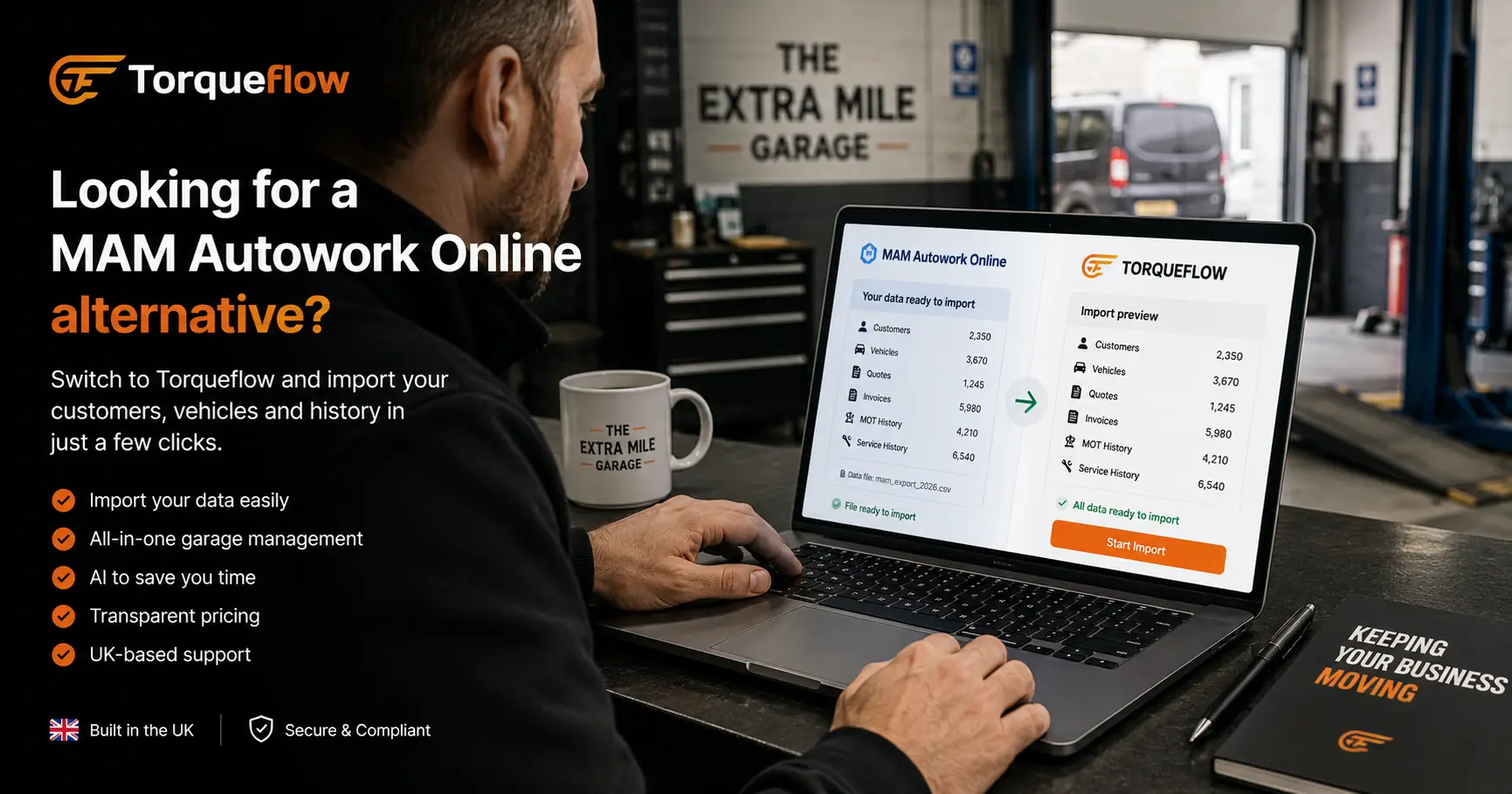
Customer records. Names, numbers, addresses, email. These export from Autowork Online as CSV or Excel files, and any credible alternative imports them. Torqueflow’s import auto-detects what each file contains, shows you a preview, and lets you approve or roll back before anything is final.
Vehicle records. Registrations, makes, models, mileage. Anything originally pulled from the DVLA gets re-fetched by the new system’s own DVLA connection the first time the vehicle is opened, so stale lookup data corrects itself.
Job and invoice history. Completed jobs, invoice lines, and payment records import so the audit trail survives. This is what makes reminders work from day one: the new system knows the Focus had a service in November and an MOT due in May.
What doesn’t transfer: the connections. Catalogue links, supplier integrations, and technical data subscriptions are services, not data. Your Autodata or Haynes subscription is yours and keeps working standalone. The supplier portals reconnect to whatever your new system supports, and as covered above, if live catalogue integration is non-negotiable, check that line before you commit to anyone.
The timeline
Shorter than you think. Day one is export and import: a few hours, most of it verification. Day two is configuration: bays, booking types, reminder schedules, the Xero connection. Then run both systems in parallel for a few days, new bookings in the new system, in-progress jobs finishing in MAM.
Autowork Online is typically on a rolling monthly contract, which makes this one of the cheaper switches in UK garage software. Worst case, you pay one overlapping month while you verify everything moved. No £1,300 onboarding fee sunk into the old system, no minimum term to run down.
Three mistakes to avoid, learned from garages who’ve done it: don’t skip the spot-check (verify 20-30 imported records against the originals before going live), don’t cancel MAM until you’ve finished a full week on the new system, and don’t import the mess. A migration is the one chance to drop the duplicate customers and the courtesy car you sold in 2019. Clean the export, then import.
Frequently asked questions
Start with the export
You don’t need to commit to anything to find out how easy leaving would be. Log into Autowork Online, export your customers and vehicles, and look at the files. That’s your business, in two spreadsheets, ready to move whenever you are.
When you want to see what it looks like on the other side, we’ll import those files into a demo and show you your own data running in Torqueflow.
Torqueflow imports your Autowork Online exports: customers, vehicles, history, invoices. DVLA lookups, SMS, and WhatsApp included, not metered.