How to Get Paid Faster at Your Independent Garage
Cash flow kills more garages than competition does. You’re paying suppliers on 30-day terms, paying staff weekly, and waiting 14-60 days for customers to settle invoices. Here’s how to close the gap between finishing a job and getting the money in the bank.
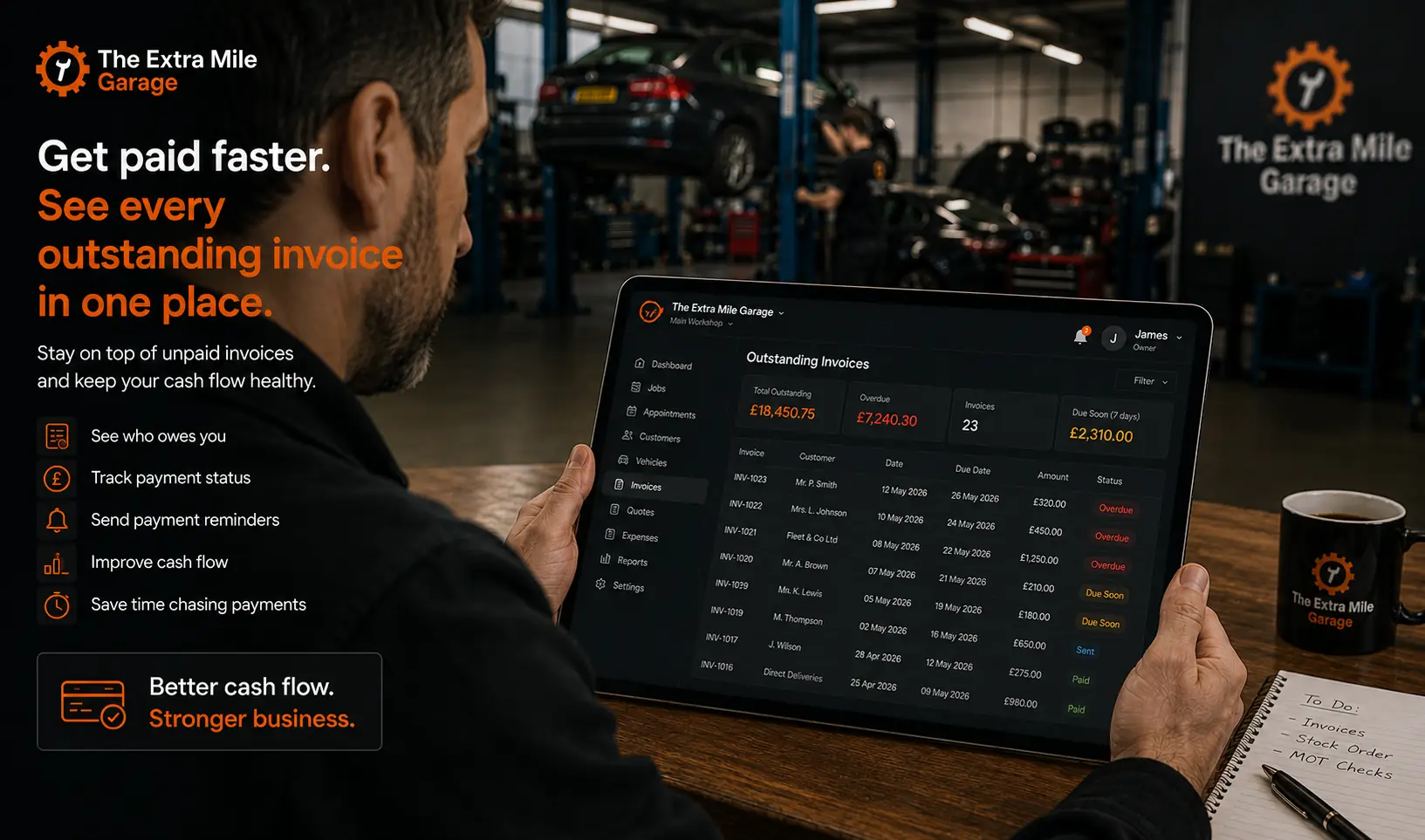
A typical 3-4 bay garage turns over £300,000-500,000 a year. Sounds healthy. But pull up the data on any given Tuesday and you’ll find £8,000-15,000 in outstanding invoices, a VAT bill due next month, and a parts supplier chasing payment for last week’s delivery. The business is profitable on paper and broke in practice.
The issue isn’t revenue. It’s the delay between earning money and receiving it. Every day a customer invoice sits unpaid is a day you’re funding their car repair out of your own cash flow.
Most UK garages operate with payment processes that were designed for a world of paper job cards and cheque books. The customer picks up the car, you hand them an invoice, they promise to pay by bank transfer, and three weeks later you’re still waiting. Or you post the invoice on Friday afternoon and it doesn’t arrive until Wednesday. That’s five days of delay before the customer even opens the envelope.
There are faster options. And they cost less than the cash flow gap they close.
Why garages get paid slowly
The problem isn’t that customers don’t want to pay. It’s that the process makes it harder than it needs to be.
Invoices go out late. The job finishes on Thursday. The invoice gets raised on Friday afternoon, or Monday if the team is busy. That’s 1-4 days of delay before the customer even knows they owe you money. In a busy workshop, invoice admin falls to the bottom of the list because there’s always another vehicle on the ramp.
Payment requires effort from the customer. Most garage invoices still ask for a bank transfer. The customer has to log into their banking app, type in your sort code and account number, enter the amount, add a reference. It’s a five-minute job that gets put off for two weeks. Every step of friction adds days to your payment terms.
Nobody chases until it’s overdue. You send the invoice and wait. Two weeks later someone notices it hasn’t been paid. They pick up the phone. The customer apologises and pays that day. But you’ve just funded their service for a fortnight because nobody sent a reminder.
Statements don’t go out. For customers with multiple jobs or ongoing accounts, a regular statement showing what’s owed is a powerful prompt. Most garages don’t send them because generating and posting statements manually is a tedious operation nobody has time for.
The Friday afternoon invoice run. Many garages batch their invoicing into a weekly session. Every job completed that week gets invoiced on Friday. A job finished on Monday doesn’t get invoiced for five days. That’s five days of free credit you didn’t intend to give.
Send invoices the moment the job is done
The single biggest thing you can do to get paid faster is reduce the time between finishing work and sending the invoice. If the invoice goes out the same day the customer collects the car, you’ve eliminated the biggest delay in the whole process.
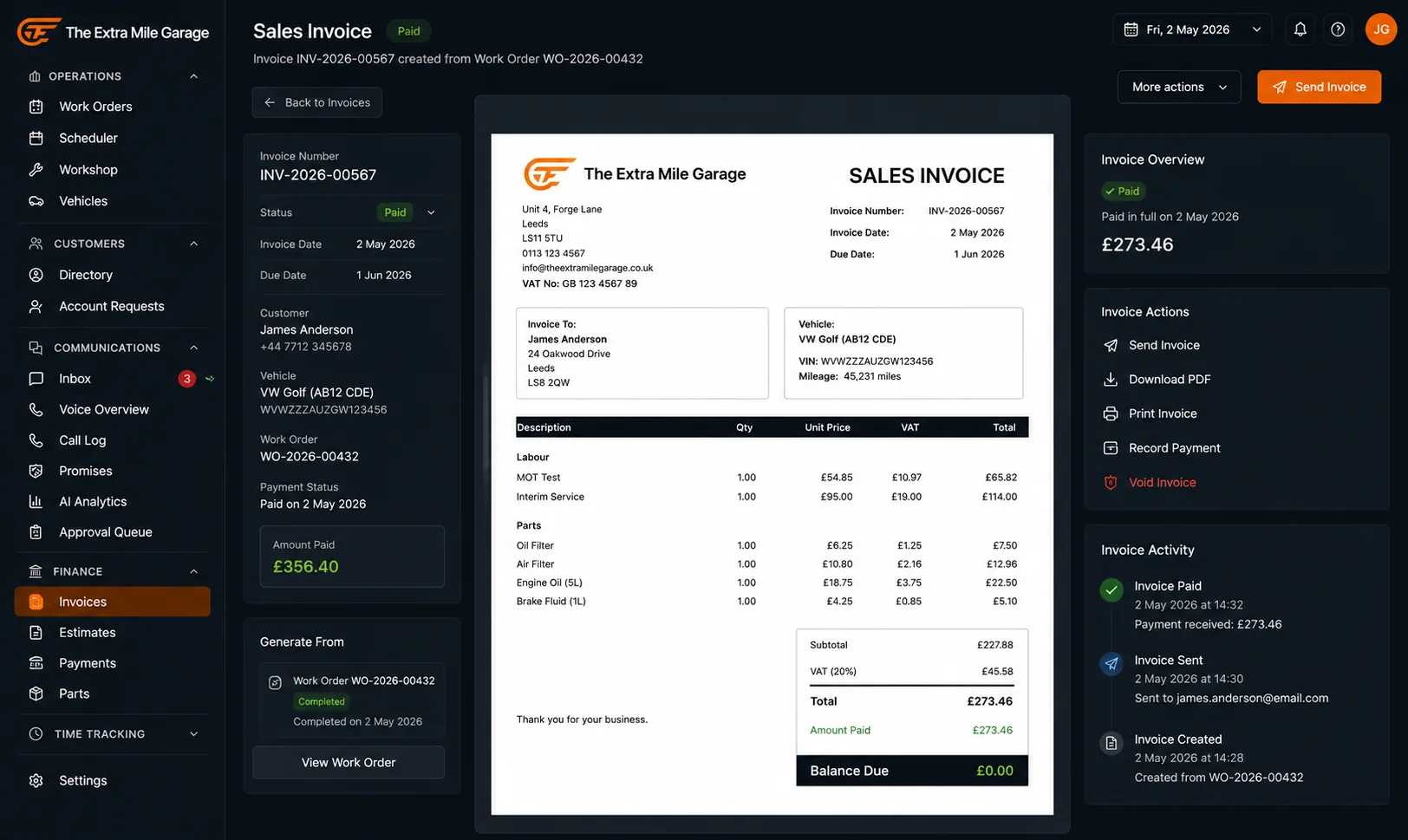
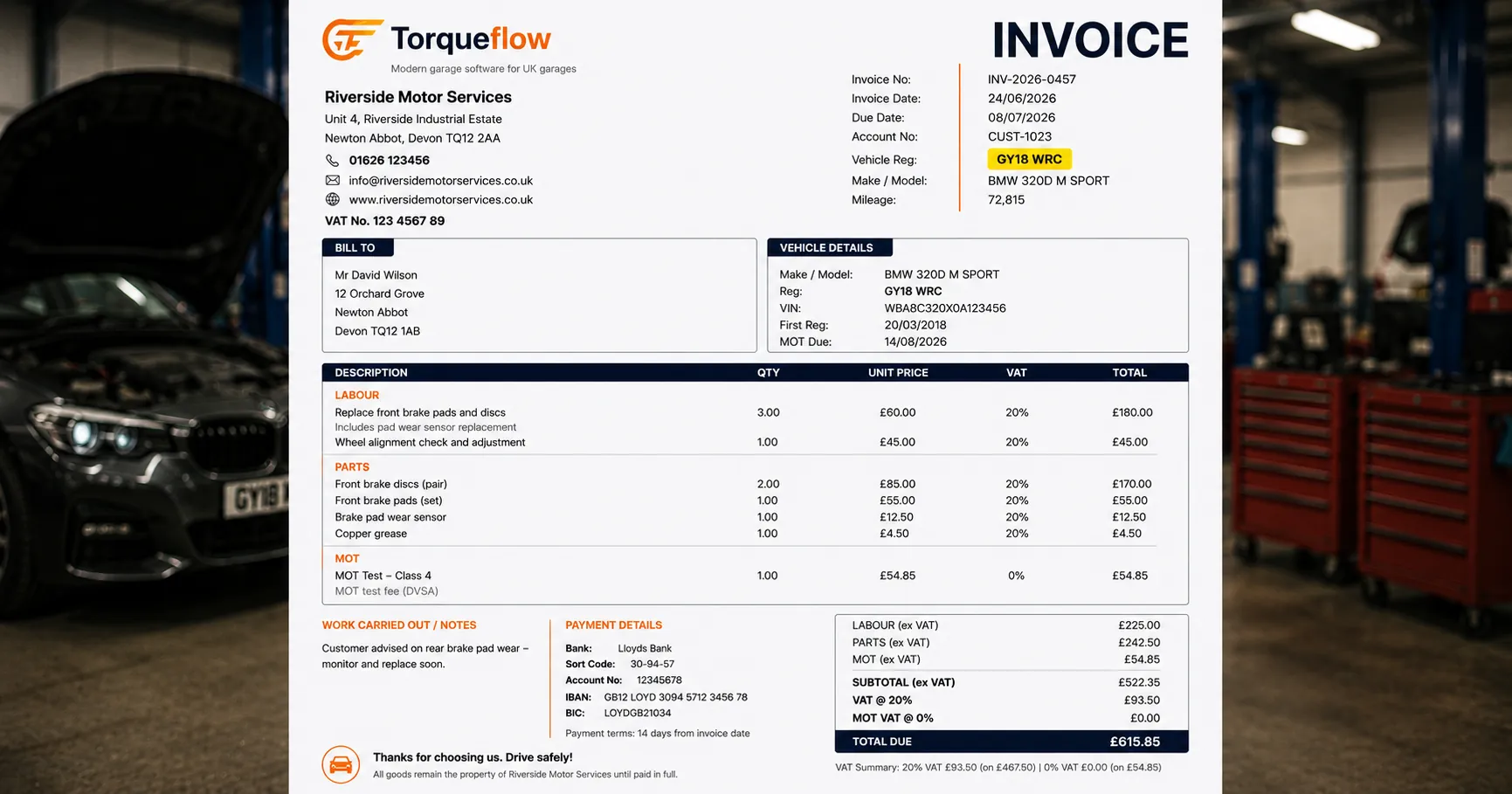
Garage management software that generates invoices directly from job cards makes this automatic. The technician closes the job. The system generates the invoice from the parts, labour, and VAT on the job card. The customer gets the invoice by email, SMS, or WhatsApp before they’ve driven home. No Friday afternoon batch run. No paperwork backlog.
For UK garages running 8-12 jobs a day, this alone can reduce average payment time by 5-7 days. That’s £2,000-4,000 in cash flow freed up at any given moment.
Give customers an online payment option
Bank transfers work. They’re also the slowest way for a customer to pay you, because they require the customer to do data entry. A pay-now link sent with the invoice lets the customer tap once, enter their card details on a secure page, and pay in 30 seconds.

Online payment through a service like Stripe means the money hits your account within 1-2 business days. Compare that to a bank transfer that might take 3-5 days after the customer eventually gets round to doing it.
The numbers are clear: garages that offer a digital pay-now link with every invoice see average payment times drop from 14-21 days to 2-5 days. Some customers pay within minutes of receiving the invoice. That’s the difference between chasing money and receiving it.
For customers with multiple outstanding invoices, a statement link that lets them pay everything in one go removes even more friction. One tap, one payment, all invoices cleared. The system splits the payment across invoices automatically.
Card machines at the front desk handle the customers who pay on collection. A contactless terminal integrated with your garage management system means the payment lands against the right invoice without anyone typing a reference number. The price of a card terminal (£20-30/month) pays for itself in the first week through faster reconciliation and fewer payment errors.
Automate payment reminders and statements
You shouldn’t have to pick up the phone to chase every late payment. Automated reminders do the chasing for you.
Set up a reminder schedule: a polite nudge 3 days after the invoice is sent, a firmer follow-up at 7 days, and a final request at 14 days. Each reminder includes the pay-now link. Most customers pay after the first or second reminder because they genuinely forgot, not because they were avoiding you.
Customer statements should go out monthly for any account with an outstanding balance. A statement that arrives with a one-click payment option converts better than a statement that arrives as a PDF the customer has to print and then manually transfer money against.
This isn’t about being aggressive with your customers. It’s about making it easy for them to pay on time. Customer expectations have changed. People pay for everything online now. If your garage is the one place that still asks them to do a manual bank transfer, you’ll be the one they pay last.
Sync your accounts in real time
If you’re raising invoices in your garage software and then re-entering them in Xero or Sage, you’re doing double the work and getting data that’s always a day behind. Every hour spent on manual bookkeeping is an hour not spent on billable vehicle work.
Two-way accounting integration means invoices, payments, and credit notes sync automatically between your workshop system and your accounting platform. When a customer pays, both systems update. When you void an invoice, both systems reflect it. Your accountant sees real-time data. You see real-time cash position.
For VAT quarters, this is critical. Instead of scrambling to reconcile invoices against payments in the last week before filing, the data is already there. Clean, matched, and ready to submit. That alone reduces the cost of your bookkeeper’s time and gives you contact with your actual financial position every day, not once a quarter.
Speed up your purchase invoice processing too
Getting paid faster is half the cash flow equation. The other half is knowing exactly what you owe and when. Most garages receive 20-40 supplier invoices per week: parts, consumables, equipment, services. Processing each one manually takes 5-10 minutes of data entry per invoice. That’s 2-3 hours per week of pure admin.
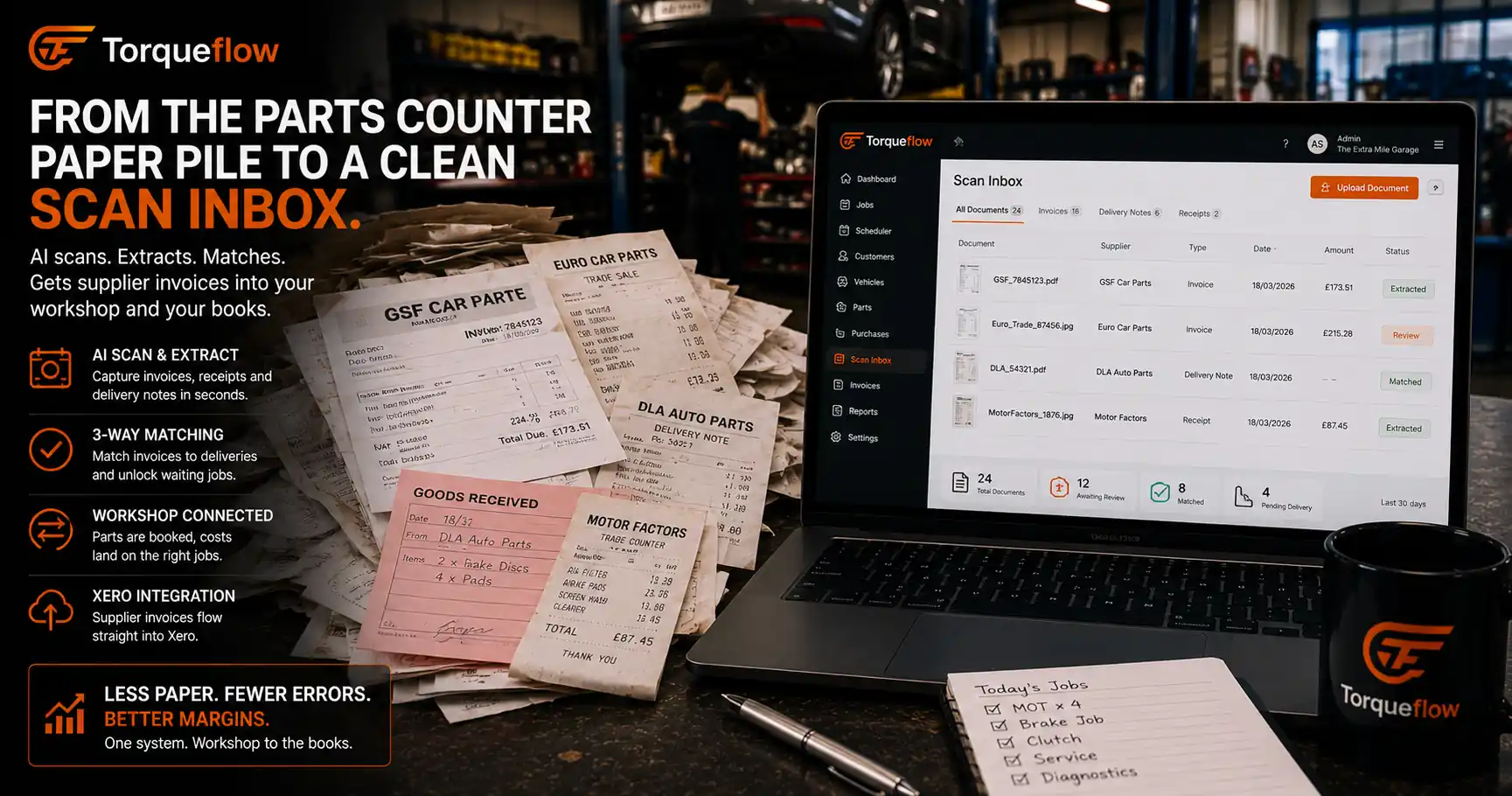
AI invoice scanning cuts this to seconds per invoice. Forward the supplier email, snap a photo of the trade-counter receipt, or drop the PDF into your system. The AI extracts the supplier, line items, quantities, prices, and VAT. You review and confirm. One click and it’s booked against the right supplier account.
This matters for cash flow because you can’t manage what you can’t see. If purchase invoices sit in a pile on the desk for a week before anyone enters them, your financial data is a week behind reality. You don’t know your true position. Automated scanning means every supplier invoice is in the system the day it arrives. You can see exactly what you owe, to whom, and when it’s due.
That visibility lets you make smart decisions about when to pay suppliers. Pay too early and you reduce your own cash buffer. Pay too late and you damage the relationship. Pay on the day the term expires and you’ve held your cash as long as possible without causing any issue.
Read more about garage invoicing software →
The cash flow calendar for UK garages
Cash flow in the automotive trade isn’t flat across the year. Knowing the pattern helps you plan.
January-February: Quiet season. MOT bookings drop after the September rush. Service work slows. This is when cash flow bites hardest because revenue dips but fixed costs don’t. Having tight payment processes matters most here.
March: MOT season starts. Bookings increase. Cash flow improves if you’re collecting payment on the day. If you’re still invoicing weekly and waiting 14 days, the March revenue doesn’t land until April.
April-May: VAT quarter for many businesses. The bill covers January-March, your quietest period. If your invoicing was slow over winter, you’re paying VAT on revenue you haven’t collected yet.
June-August: Steady. Holiday season means some weeks are quieter, but servicing and MOT work continue.
September-October: Second MOT peak. Busiest time for many garages. The risk here is the team getting so busy with vehicle work that admin slips. Invoices go out late. Payments aren’t chased. You do £50,000 of work in September and spend October trying to collect it.
November-December: Slowdown begins. Customers defer non-urgent work until January. This is when outstanding invoices from September need to be zero. If they’re not, you’re carrying that debt into the quiet season.
The garages that grow through these cycles aren’t necessarily doing more jobs. They’re getting paid faster for the jobs they do. The difference between a 5-day average payment time and a 21-day average is roughly one month’s operating cost sitting permanently in unpaid invoices.
Frequently asked questions
Stop funding your customers’ car repairs
Every day between finishing a job and getting paid is a day you’re lending your customer money at 0% interest. Online payment links, card machines, automated reminders, and same-day invoicing turn a 14-21 day payment cycle into a 1-3 day one. For a garage doing £400,000 a year, that’s the difference between £15,000 permanently tied up in unpaid invoices and having that money in the bank where it belongs. Run your workshop. Get paid the same day. Move on to the next job.
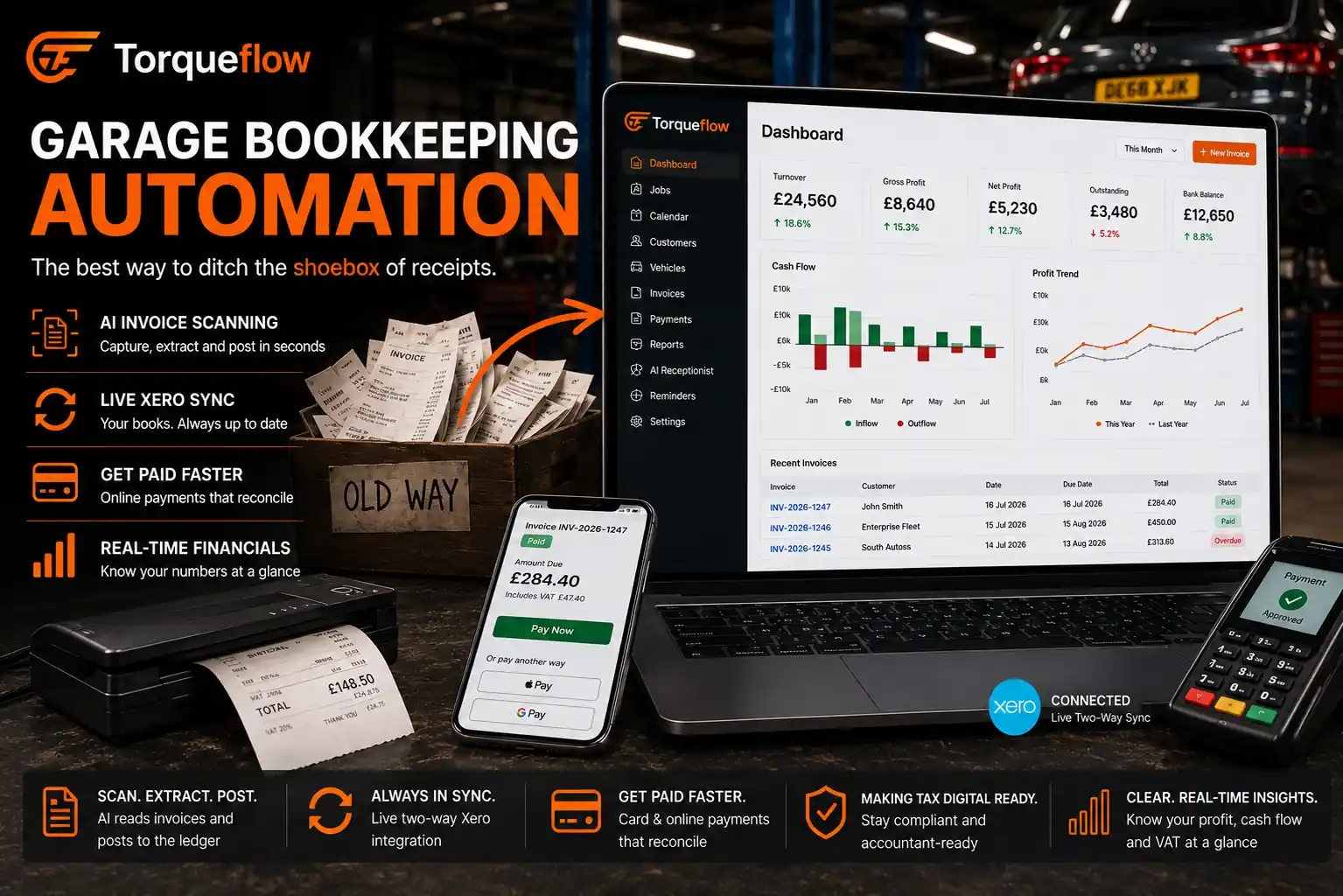
Torqueflow generates invoices from job cards, sends pay-now links via WhatsApp, and syncs with Xero in real time. Stop chasing payments.