Why WhatsApp Is Replacing Email for Garage Customer Communication
Email open rates for garages sit around 20%. WhatsApp open rates are 90%+. That’s not a marginal improvement. It’s a different communication channel entirely. Here’s why UK garages are switching to WhatsApp for customer messages, what they’re using it for, and how to set it up without giving out your personal number.
Your service advisor sends an email to confirm a booking. It lands in the Promotions tab. The customer doesn’t see it. Two days later they call to check whether the booking went through. Or they don’t call and just don’t show up.
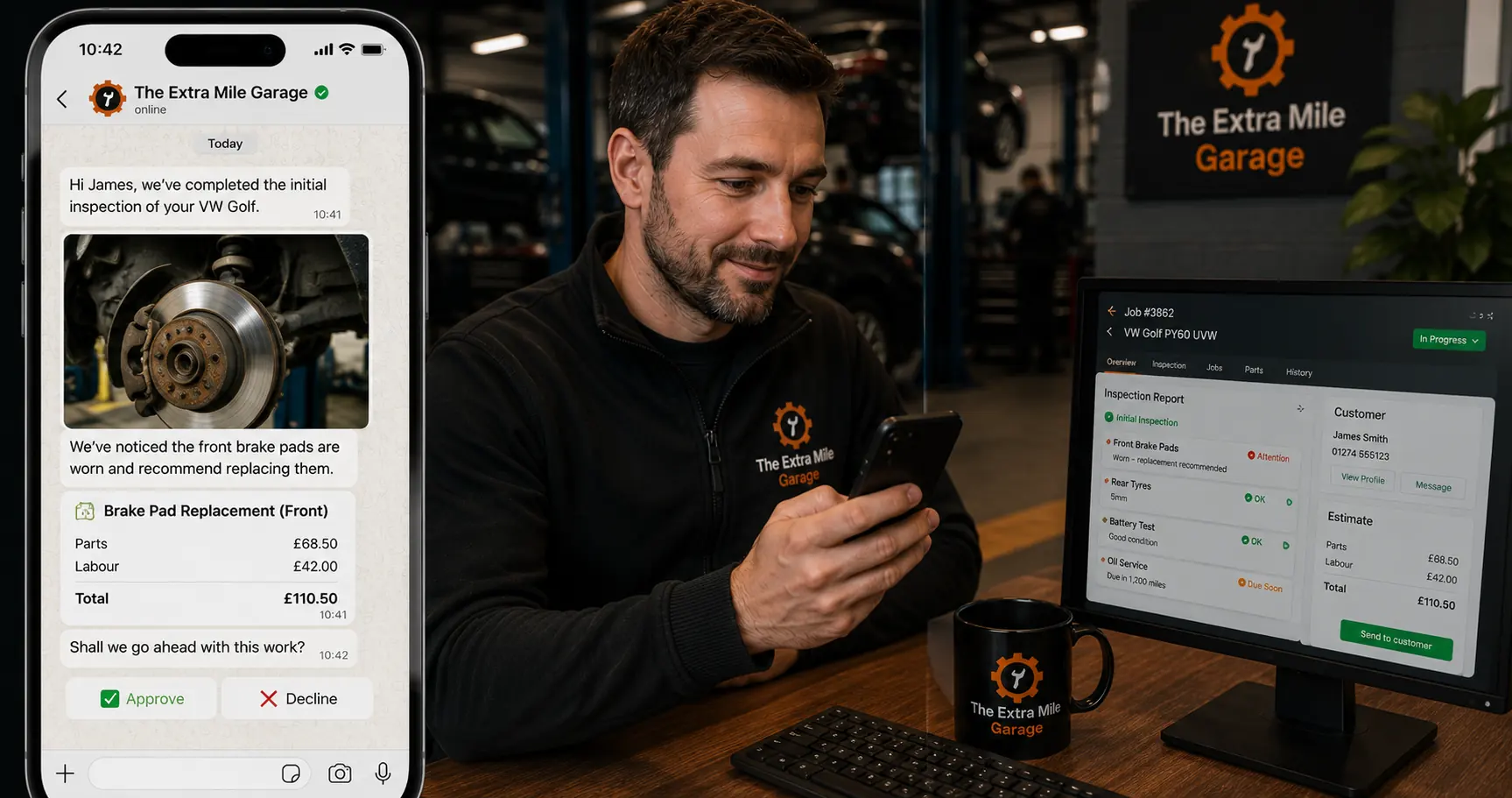
Your technician finds worn brake pads during an MOT. The advisor sends an email with the quote and a photo. The customer checks their phone, sees the notification, but it’s between a Tesco Clubcard email and a PPI claim. They’ll look at it later. Later never comes. The quote expires. The work doesn’t get approved. You’ve lost the upsell and the customer drives on worn brakes.
Now picture the same scenarios on WhatsApp. The booking confirmation arrives in the same app the customer uses 50 times a day. They see it within minutes. The quote with the photo of the worn pads arrives as a WhatsApp message. The customer taps to approve, replies “go ahead”, and the work starts. Same information. Different channel. Completely different result.
That’s why WhatsApp is replacing email for garage customer communication across the UK. Not because it’s newer. Because customers actually read it.
Why email stopped working for garages
Email was the default business communication channel for two decades. For garages, it’s now the worst-performing one.
Open rates are collapsing. The average open rate for automotive service emails in the UK is 18-22%. That means 4 out of 5 customers never see your message. Gmail’s Promotions tab, Outlook’s Focused inbox, and aggressive spam filters mean your booking confirmations sit unread next to the Domino’s voucher.
Customers don’t check email for urgent things. When a customer needs to know if their car is ready, they check their phone. Not their inbox. Email is for newsletters and receipts, not real-time updates. A service update via email arrives 3-6 hours after the customer stops checking.
No easy reply path. Replying to a garage email feels formal. The customer has to compose a response, type a greeting, explain what they want. On WhatsApp, they tap and type “yes” or “what time?” The friction difference between these two interactions explains why WhatsApp messages get 5-10x more responses than email.
Garages aren’t set up for email marketing. Most independent garages don’t have an email list, a template system, or the time to write emails. The “email” they send is usually a PDF invoice attached to a plain-text message from a personal Gmail account. It looks unprofessional and often triggers spam filters.
Why customers prefer WhatsApp
WhatsApp is on 95% of UK smartphones. Your customer already has it. They already use it constantly. A message from your garage sits in the same app as their family group chat and their football WhatsApp group.
90%+ open rates. WhatsApp messages are read within minutes, not hours. The notification appears on the lock screen. The customer doesn’t have to open an app, navigate to an inbox, or filter through spam. The message is just there.
Rich messages. You can send photos or videos of the repair work, documents like invoices and quotes, payment links, and booking confirmations. A WhatsApp message showing the customer a photo of their worn brake pads with “shall we replace these today?” converts at a completely different rate to an email they never opened.
Two-way conversation. WhatsApp is a conversation, not a broadcast. The customer can reply instantly. “Yes, go ahead.” “What will it cost?” “Can you do it tomorrow instead?” That back-and-forth happens in real time, not over a 24-hour email exchange.
Trust. Customers trust WhatsApp messages more than email because they associate WhatsApp with personal communication. A message from a business on WhatsApp feels like a message from a person. An email from a business feels like marketing.
What garages use WhatsApp for
The use cases go well beyond “texting the customer.” Garages integrating WhatsApp into their garage management software are using it as a primary communication channel for the entire customer interaction.
Booking confirmations and service reminders. When a customer books an MOT, the confirmation goes via WhatsApp instantly. Automated service reminders at 30, 14, and 3 days before the due date keep the booking top of mind. These automated WhatsApp reminders replace the letter that went behind the toaster.
Read more about MOT reminders that get opened →
Job status updates. “Your car is on the ramp.” “We’ve started the service.” “All done, ready for collection at 3pm.” These real-time updates via WhatsApp replace the anxious “is my car ready?” phone call that interrupts your workshop at 2pm every day.
Quote approval. The technician finds additional work during an inspection. The service advisor sends the quote via WhatsApp with a photo of the issue. The customer taps to approve. No phone tag. No email that gets lost. The approval comes back in minutes, not hours. This speeds up workflow and means more work gets approved because the customer can see the evidence.
Payment links. The invoice arrives via WhatsApp with a “Pay now” link. The customer taps, enters their card, and pays in 30 seconds. Compare that to an emailed invoice with bank transfer details that sits in the inbox for two weeks.
Follow-up and aftercare. A “How was your service?” message after collection. A reminder that the advisory items from the last MOT need attention. A seasonal promotion for a winter check. These followup messages keep the customer engaged between visits and build the relationship that drives retention.
The personal phone problem (and how to fix it)
Most garages that use WhatsApp today are doing it wrong. Chloe has WhatsApp Business on her personal phone. She messages customers from it. When Chloe goes on holiday, nobody can see the conversation history. When Chloe leaves, those customer relationships leave with her.
Using personal phones for garage WhatsApp communication creates three problems:
- No visibility. The workshop owner can’t see what’s been said to customers. There’s no dashboard, no record, no audit trail. If a customer disputes what they were told, it’s Chloe’s word vs theirs.
- No continuity. When the person holding the phone isn’t available, messages go unanswered. Customer data lives on one device instead of in the business.
- GDPR risk. Customer phone numbers and conversation history on a personal device is a data protection concern. If that phone is lost or stolen, customer data goes with it. You need a clear opt-out option for marketing messages, and personal phones don’t track consent.
The fix is a WhatsApp Business API integration connected to your garage management software. This gives your garage a single WhatsApp business account that the whole team can access from a shared inbox. Every message is logged against the customer record. Any team member can pick up a conversation. The customer sees your garage name and logo, not Chloe’s profile photo.
WhatsApp automation handles the routine messages (booking confirmations, reminders, status updates) without anyone sending them manually. The team only picks up conversations that need a human response: questions, complaints, complex approvals.
This is the difference between “we use WhatsApp” and “WhatsApp is integrated into how we run the garage.”
How to start using WhatsApp for your garage
You don’t need to build anything from scratch. Garage management software with WhatsApp integration handles the technical setup.
Step 1: Connect a business account. Your garage gets a verified WhatsApp business account with your garage name, address, and logo. Customers can message this account directly. It’s not tied to anyone’s personal phone.
Step 2: Set up automated messages. Configure booking confirmations, service reminders, and job status notifications to go via WhatsApp automatically. These messages are triggered by events in your garage management system, not sent manually.
Step 3: Use the shared inbox. Every WhatsApp conversation appears in the same inbox as SMS, phone calls, and portal messages. Any team member can respond. The full conversation history is visible. Nothing falls through the cracks.
Step 4: Collect consent. GDPR requires opt-in for WhatsApp marketing messages. Collect consent at the point of registration or first visit. Most garage management software tracks this automatically and only sends messages to consented customers.
The transition from email to WhatsApp typically takes a day to configure and a week for the team to get comfortable. After that, nobody asks to go back to email.
Frequently asked questions
Your customers are already on WhatsApp. Your garage should be too.
Email had its place. That place was 2015. In 2026, sending a garage customer an email is like sending them a letter. It might arrive. They might read it. They probably won’t. WhatsApp puts your message where the customer already lives: on their phone, in their most-used app, read within minutes. Booking confirmations, service reminders, job updates, quote approvals, and payment links all work better on WhatsApp. The channel shift has happened. The only question is whether your garage has caught up.
Torqueflow integrates WhatsApp into your garage workflow. Automated reminders, quote approvals with photos, payment links, and a shared team inbox. Stop sending emails nobody reads.